Operating sequence
Pressure, vacuum, steam-out, cooling, blocked-in and upset cases are mapped to the real process cycle.

Dual-envelope mechanical design
A custom vessel mechanically designed for the defined combination of internal pressure, external pressure and vacuum operating cases.
Quick answer
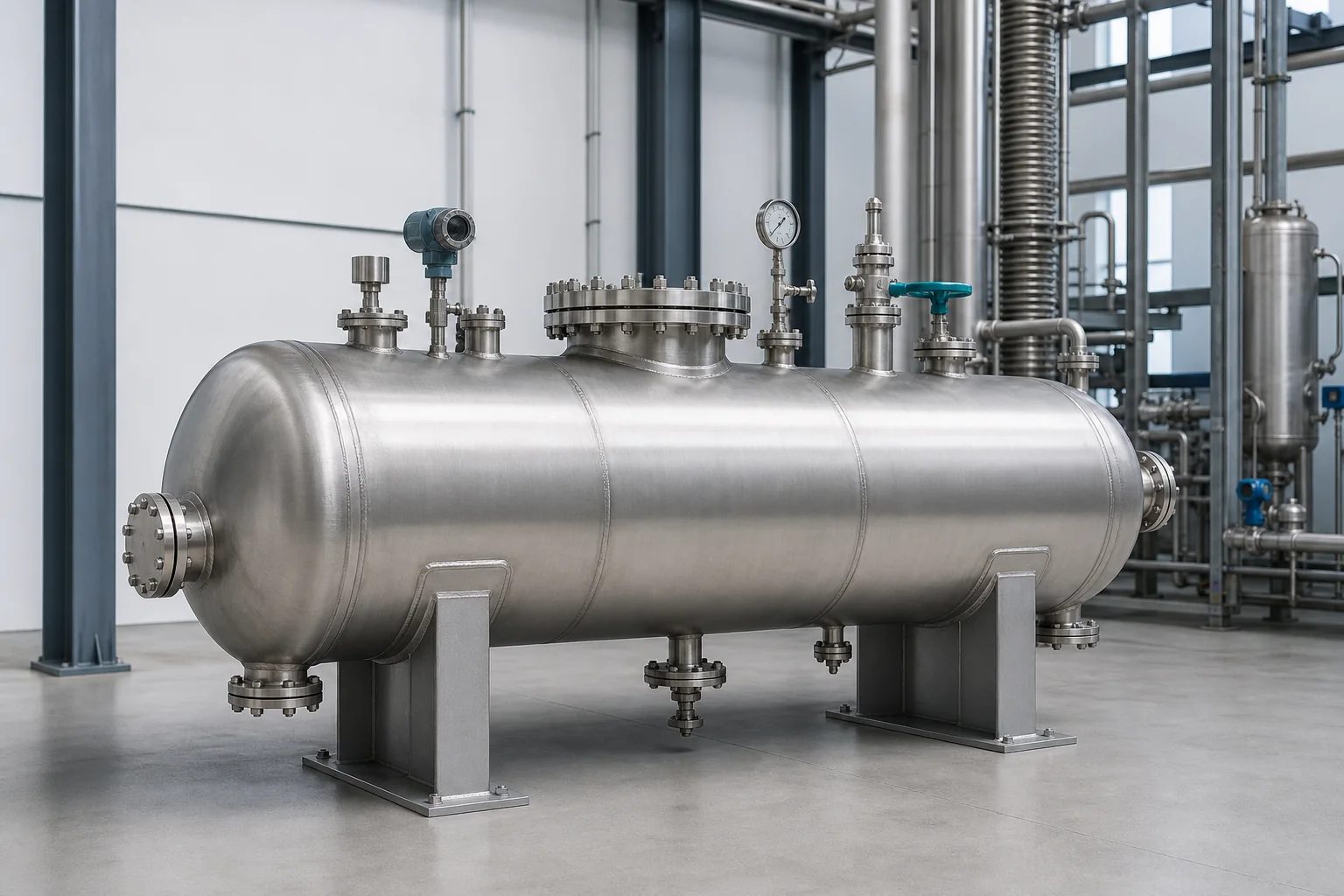
A pressure and vacuum vessel is checked for more than positive internal pressure. It must also resist the external pressure created under partial or full vacuum. Geometry, wall stability, stiffening, supports, temperature and repeated pressure-to-vacuum cycles are evaluated as connected design cases.
Vacuum failure is commonly governed by buckling rather than simple tensile stress. Out-of-roundness, unsupported shell length, nozzles, jacket pressure and temperature can all affect external-pressure stability.
Vessentra defines the positive-pressure and vacuum cases with the process sequence, then coordinates shell geometry, reinforcement, supports, nozzles, venting and vacuum protection.
Typical applications
Application details are reviewed before equipment configuration is finalised.
Engineering configuration
The equipment is developed from process inputs, operating conditions, cleaning requirements and site interfaces.
Pressure, vacuum, steam-out, cooling, blocked-in and upset cases are mapped to the real process cycle.
Shell proportions, heads, stiffening and unsupported lengths are evaluated for the specified vacuum and temperature.
Vacuum breakers, relief connections, vents, condensate paths and interlocks are coordinated with the surrounding system.
Supports, nozzle loads, liquid head, transport, lifting, wind and seismic requirements are included where applicable.
Specification guidance
Project limits are confirmed through engineering review. These fields describe the decisions needed for an accurate, application-specific configuration.
| Positive pressure | Project-defined internal design pressure |
|---|---|
| Vacuum condition | Partial or full vacuum as specified |
| Temperature envelope | Normal, cleaning and upset cases defined |
| Orientation | Vertical or horizontal |
| Stiffening | Provided when required by stability calculations |
| Product-contact material | Selected from process and cleaning compatibility |
| Protection connections | Relief, vent and vacuum-breaker interfaces by system design |
| Cycle basis | Operating sequence and expected cycles reviewed |
Common questions
No. Internal and external pressure create different failure modes. Full-vacuum suitability must be explicitly included in the mechanical design.
The vessel is assessed for the maximum credible external differential pressure when internal absolute pressure approaches its specified minimum.
Yes, when both conditions, transition temperatures, expected cycles and relevant upset cases are included in the design basis.
The need, size and set point depend on the process, vessel rating and failure scenarios and should follow the complete safeguarding review.
Talk to engineering
Share the product, working volume, operating conditions, cleaning method and project location. We will use them to structure the next engineering conversation.