Design envelope
Design pressure, temperature, vacuum cases, medium, liquid head, cycles and external loads are defined before calculations and detailing.
Code-led custom fabrication
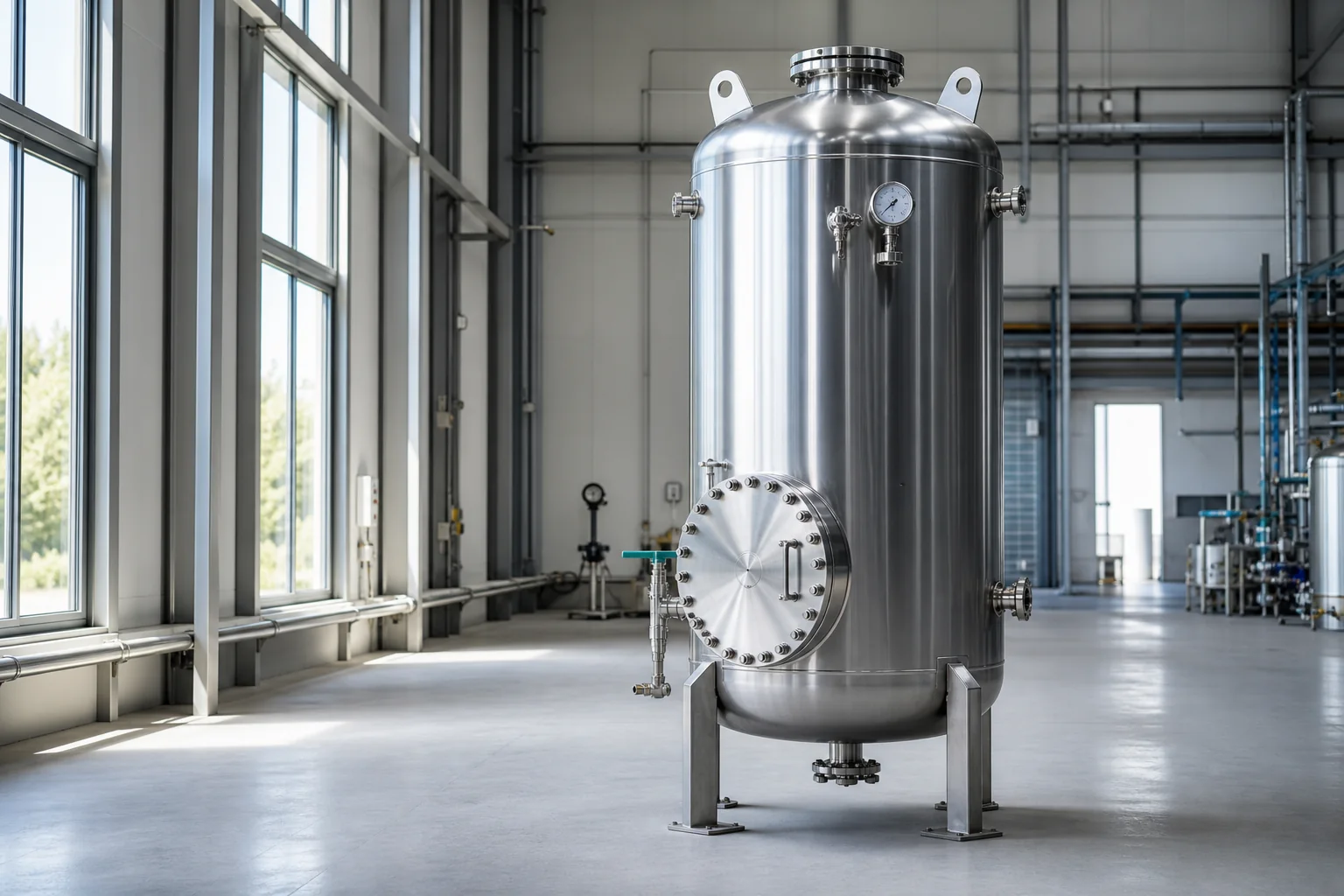
A project-specific stainless steel pressure vessel developed from the process duty, mechanical loads and agreed ASME code scope.
Quick answer
A custom ASME stainless steel pressure vessel is engineered around a documented design basis and the applicable rules of ASME Section VIII when that code scope is specified. Pressure, temperature, process medium, corrosion allowance, external loads, inspection, testing and documentation are coordinated before fabrication begins.
The vessel name alone does not define a safe design. Normal and upset conditions, liquid head, vacuum cases, cyclic service, nozzle loads, wind or seismic loads and installation details all influence the mechanical arrangement.
Vessentra develops vessel geometry, heads, supports, nozzles, access, lifting features and project documentation as one package. Code stamping, third-party inspection and jurisdictional registration are included only when confirmed in the agreed supply scope.
Typical applications
Application details are reviewed before equipment configuration is finalised.
Engineering configuration
The equipment is developed from process inputs, operating conditions, cleaning requirements and site interfaces.
Design pressure, temperature, vacuum cases, medium, liquid head, cycles and external loads are defined before calculations and detailing.
Product-contact alloy, non-pressure parts, corrosion allowance, gasket and bolting selections follow the service and project specification.
Orientation, head type, supports, nozzles, manways, lifting points and maintenance clearances are coordinated with the installation.
Material traceability, welding records, examination, testing and turnover documentation are planned against the agreed code and inspection scope.
Specification guidance
Project limits are confirmed through engineering review. These fields describe the decisions needed for an accurate, application-specific configuration.
| Design standard | ASME Section VIII scope confirmed for the project |
|---|---|
| Design conditions | Pressure, temperature, vacuum and load cases defined by design basis |
| Product-contact material | Stainless steel or project-selected corrosion-resistant alloy |
| Orientation | Vertical or horizontal arrangement |
| Heads and shell | Geometry established through mechanical design |
| Connections | Flanged, hygienic or project-specified nozzle schedule |
| Inspection and testing | Defined by code, service and purchaser requirements |
| Documentation | Project-specific calculation, fabrication and quality dossier |
Common questions
Provide the process medium, working volume, design pressure and temperature, vacuum condition, orientation, materials, corrosion allowance, nozzle schedule, support preference, installation location, design cycles and required documentation.
No. Code construction, stamping, third-party inspection and jurisdictional registration must be confirmed for the destination and included in the agreed project scope.
Sanitary or hygienic process connections can be coordinated with the pressure design when their type, rating, gasket, service condition and code acceptability are established during engineering.
Yes. Nozzle type, size, rating, reinforcement and orientation can be developed around process piping, instruments, access and allowable external loads.
Talk to engineering
Share the product, working volume, operating conditions, cleaning method and project location. We will use them to structure the next engineering conversation.