Heat-duty definition
Batch mass, product properties, start and target temperatures, cycle time, heat losses and fouling basis establish the required area.

Pressure with thermal control
A pressure vessel with an engineered jacket for controlled heating, cooling or temperature holding throughout the process cycle.
Quick answer
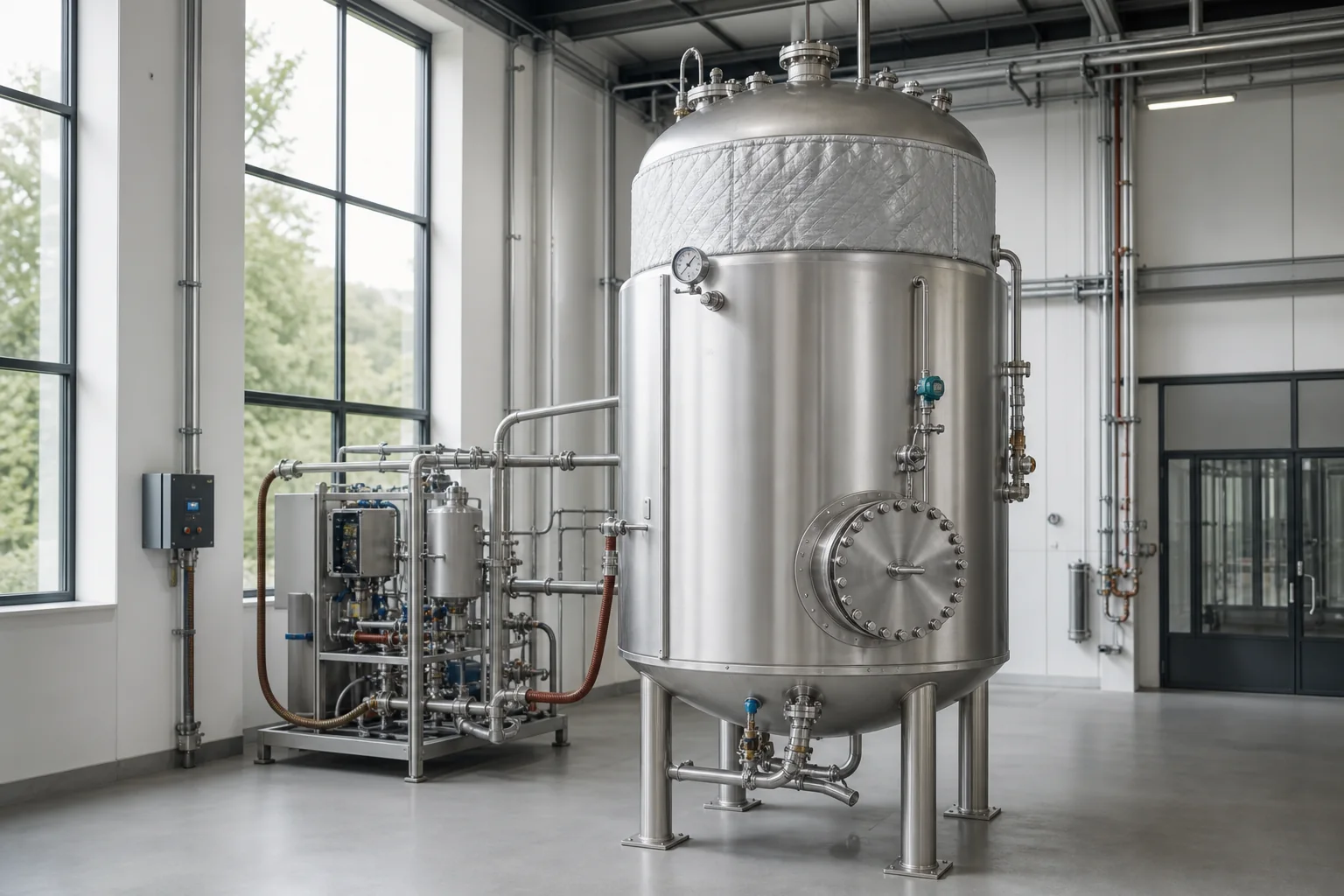
A jacketed stainless steel pressure vessel uses a separate utility circuit around the pressure shell to add or remove heat. Jacket type, zones, utility pressure, flow path, insulation and controls are selected from the process heat duty rather than from vessel volume alone.
The product side and jacket side are separate pressure systems. Each requires its own design conditions, connections, relief philosophy and test basis. Heating and cooling rates also depend on product properties, fouling, agitation and available utilities.
Vessentra coordinates the vessel, dimple jacket, half-pipe coil or conventional jacket with baffles, utility manifolds, temperature measurement and insulation. Thermal performance and mechanical design are reviewed together before geometry is fixed.
Typical applications
Application details are reviewed before equipment configuration is finalised.
Engineering configuration
The equipment is developed from process inputs, operating conditions, cleaning requirements and site interfaces.
Batch mass, product properties, start and target temperatures, cycle time, heat losses and fouling basis establish the required area.
Dimple, half-pipe or conventional jacket arrangements are evaluated against utility conditions, pressure and fabrication requirements.
Zones, manifolds, traps, vents, sensors and control valves are arranged to distribute the heating or cooling medium predictably.
Shell, jacket, insulation, supports, nozzles and thermal expansion are coordinated for the complete operating envelope.
Specification guidance
Project limits are confirmed through engineering review. These fields describe the decisions needed for an accurate, application-specific configuration.
| Product-side design | Pressure, temperature and vacuum defined by process basis |
|---|---|
| Jacket-side design | Utility pressure and temperature defined separately |
| Jacket arrangement | Dimple, half-pipe or conventional jacket by duty |
| Product-contact material | Stainless steel or project-selected alloy |
| Utility media | Steam, water, glycol or approved thermal fluid |
| Insulation | Optional insulation and stainless external cladding |
| Temperature control | Local instruments or TCU and automation integration |
| Thermal sizing | Calculated from agreed process and utility data |
Common questions
The selection depends on heat duty, utility pressure, vessel diameter, fabrication constraints, fouling, required zones and control response.
A shared or zoned jacket may support multiple utilities when changeover, ratings, drainage, thermal shock and controls are engineered for both conditions.
No, but agitation can materially improve product-side heat transfer and temperature uniformity. The need depends on viscosity, solids and the process cycle.
Provide batch quantity, density, heat capacity, viscosity, temperatures, required cycle time, utility conditions, agitation details, fouling allowance and ambient conditions.
Talk to engineering
Share the product, working volume, operating conditions, cleaning method and project location. We will use them to structure the next engineering conversation.