Filtration basis
Fluid properties, flow, particle load, retention, clean pressure drop and change-out limit establish housing size.

Pressure-rated liquid filtration
A pressure-rated stainless steel housing configured around the filter element, flow, solids loading, cleanliness and change-out method.
Quick answer
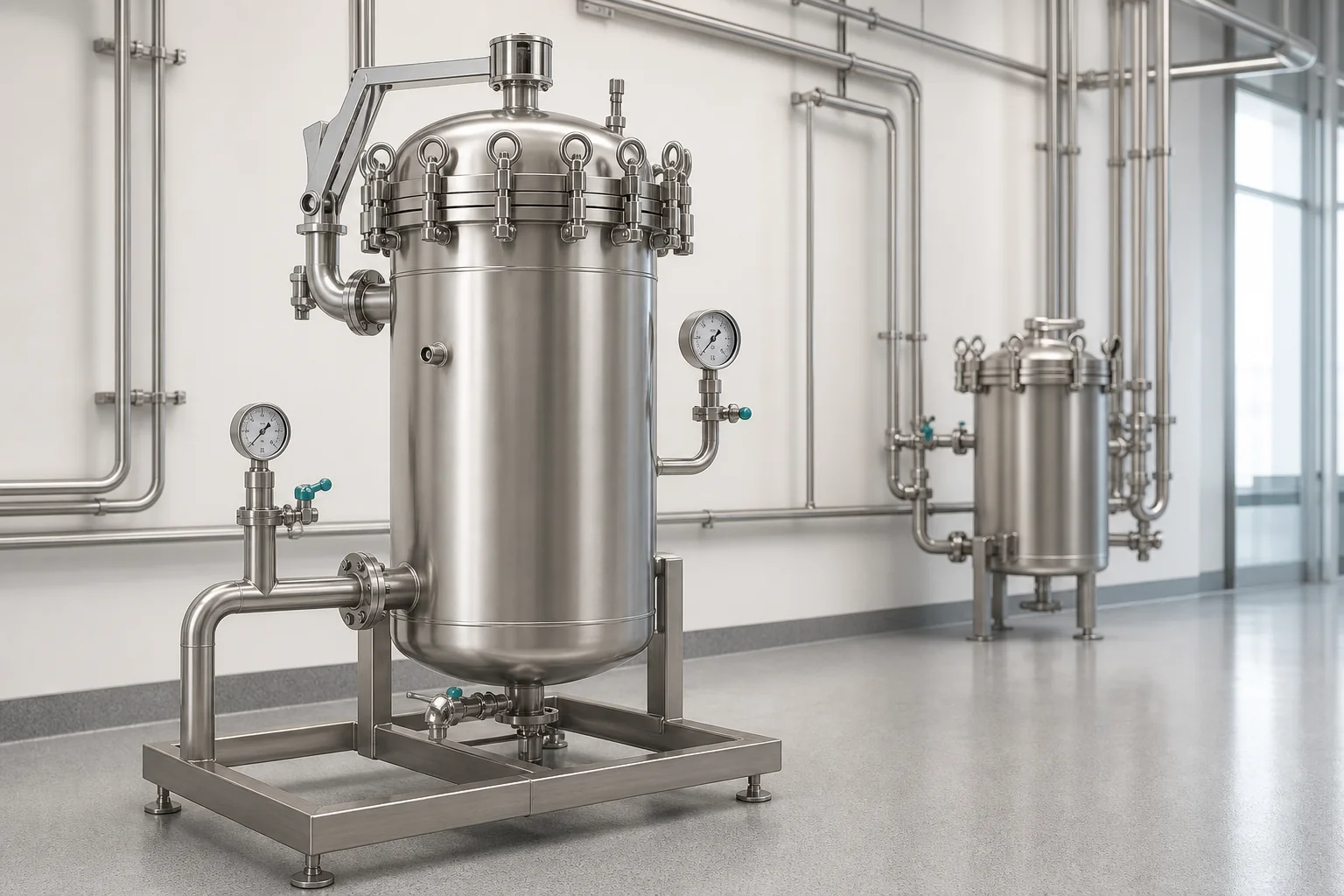
A stainless steel filter vessel contains bag, cartridge or other replaceable filter elements under pressure. Housing diameter, element count, inlet and outlet arrangement, closure, venting, drainage and differential-pressure monitoring are selected from the fluid, flow rate, solids load and required filtration result.
The filter media establishes retention performance; the vessel must distribute flow without bypass, contain pressure and allow safe element change-out. Viscosity, clean pressure drop and contamination risk influence the arrangement.
Vessentra develops the housing around the selected filter format and procedure. Closure safeguards, lifting assistance, internal sealing, surface finish, venting, drainage and skid piping are coordinated.
Typical applications
Application details are reviewed before equipment configuration is finalised.
Engineering configuration
The equipment is developed from process inputs, operating conditions, cleaning requirements and site interfaces.
Fluid properties, flow, particle load, retention, clean pressure drop and change-out limit establish housing size.
Single or multi-cartridge, single or multi-bag and project-specific internals control sealing and flow distribution.
Bolted, swing-bolt or approved quick-opening closure, lifting aid and clearance are selected for safe maintenance.
Vents, drains, differential-pressure instruments, isolation, bypass and optional skid piping follow the procedure.
Specification guidance
Project limits are confirmed through engineering review. These fields describe the decisions needed for an accurate, application-specific configuration.
| Filter format | Bag, cartridge or project-selected element system |
|---|---|
| Flow and viscosity | Defined at minimum and maximum conditions |
| Filtration target | Element retention selected by process requirement |
| Design conditions | Project-defined pressure and temperature |
| Product-contact material | 304, 316L or service-compatible alloy |
| Closure | Pressure-rated design with selected opening method |
| Monitoring | Upstream, downstream or differential-pressure indication |
| Finish and cleaning | Industrial or hygienic configuration by application |
Common questions
The vessel safely contains pressure, distributes flow and seals elements. The bag, cartridge or other media provides particle retention.
Element count depends on flow, viscosity, allowable pressure drop, solids loading, filtration area, run time and selected media.
Yes. Finish, drainability, internal sealing, hygienic connections, cleanability and change-out can be developed for the required hygiene level.
Provide fluid, temperature, pressure, flow, viscosity, solids, retention, filter element, cleaning, connections and change-out expectations.
Talk to engineering
Share the product, working volume, operating conditions, cleaning method and project location. We will use them to structure the next engineering conversation.