Hygienic boundary
Product-contact finish, weld treatment, gasket exposure and connection design are selected from the product and cleaning risk.

Hygienic pressure containment
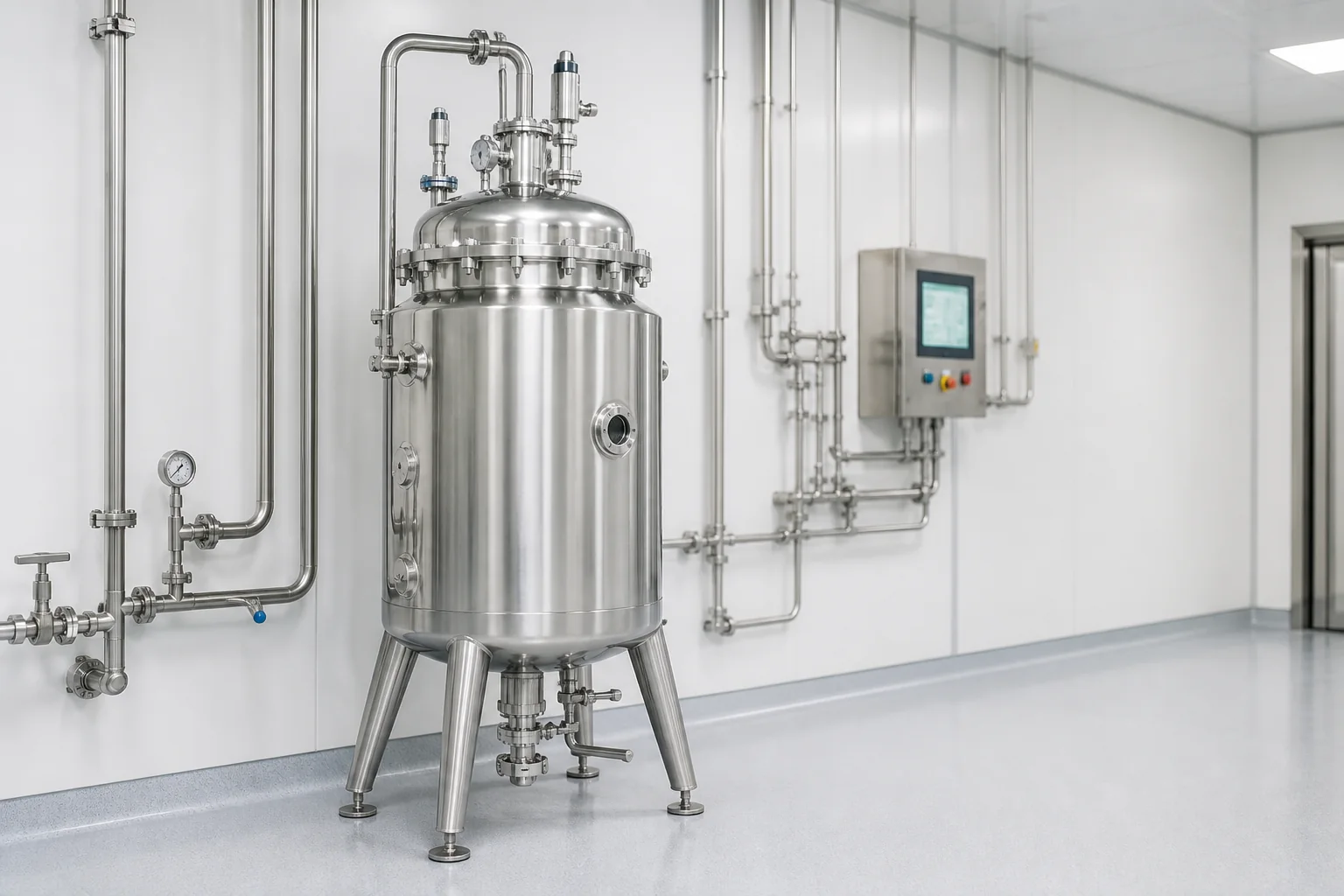
A hygienic pressure vessel combining defined pressure containment with cleanable product-contact surfaces and drainable process connections.
Quick answer
A sanitary stainless steel pressure vessel contains a process under defined pressure or vacuum while supporting hygienic production. Its product-contact finish, weld treatment, drainability, seals, nozzles, spray coverage and sampling points are coordinated with the cleaning strategy and contamination-control requirements.
Hygienic appearance is not sufficient by itself. Product retention, gasket exposure, instrument pockets, venting, condensate drainage and the route taken by cleaning fluid must be assessed with the same care as shell thickness and nozzle reinforcement.
Vessentra aligns the pressure boundary with sanitary internals, surface finish, CIP or SIP provisions, aseptic interfaces and cleanroom access. Final hygienic standard, pressure code and validation deliverables are agreed for the destination and process risk.
Typical applications
Application details are reviewed before equipment configuration is finalised.
Engineering configuration
The equipment is developed from process inputs, operating conditions, cleaning requirements and site interfaces.
Product-contact finish, weld treatment, gasket exposure and connection design are selected from the product and cleaning risk.
Drainability, spray devices, return path, venting and inspection access are coordinated with manual cleaning, CIP or SIP requirements.
Hygienic nozzles, instruments, sampling valves and safety accessories are checked against the vessel design conditions.
Supports, insulation, external finish, access and maintenance routes are developed for the utility room, process suite or cleanroom.
Specification guidance
Project limits are confirmed through engineering review. These fields describe the decisions needed for an accurate, application-specific configuration.
| Process duty | Hygienic pressurised or vacuum service |
|---|---|
| Design conditions | Project-defined pressure, temperature and vacuum envelope |
| Product-contact material | Typically 316L or project-selected alloy |
| Internal finish | Mechanical or electropolished finish defined by hygiene plan |
| Connections | Pressure-rated hygienic or flanged interfaces |
| Cleaning | Manual, CIP-ready or SIP-ready project configuration |
| Drainability | Vessel and piping interfaces reviewed for intended installation |
| Documentation | Material, finish, welding and test records to agreed scope |
Common questions
Sanitary design addresses cleanable materials, product-contact finish, weld quality, gasket interfaces, drainability, dead legs, spray coverage and contamination-controlled access in addition to pressure containment.
It can be configured for a defined CIP or SIP cycle when cleaning media, temperature, pressure, condensate management, spray coverage and the required hygienic standard are included in the design basis.
316L is common for hygienic service, but the correct alloy depends on product chemistry, chlorides, temperature, cleaning agents, exposure time and the applicable project specification.
The agreed package may include material certificates, weld records, surface-finish records, pressure tests, inspection reports and project-specific qualification support.
Talk to engineering
Share the product, working volume, operating conditions, cleaning method and project location. We will use them to structure the next engineering conversation.