Powder characteristics
Bulk density, particle behaviour, solubility, dusting and lumping tendency guide the induction method.

Controlled powder incorporation
A mixing system configured to wet, disperse or dissolve soluble powders into liquid while managing addition sequence, dust and recirculation.
Quick answer
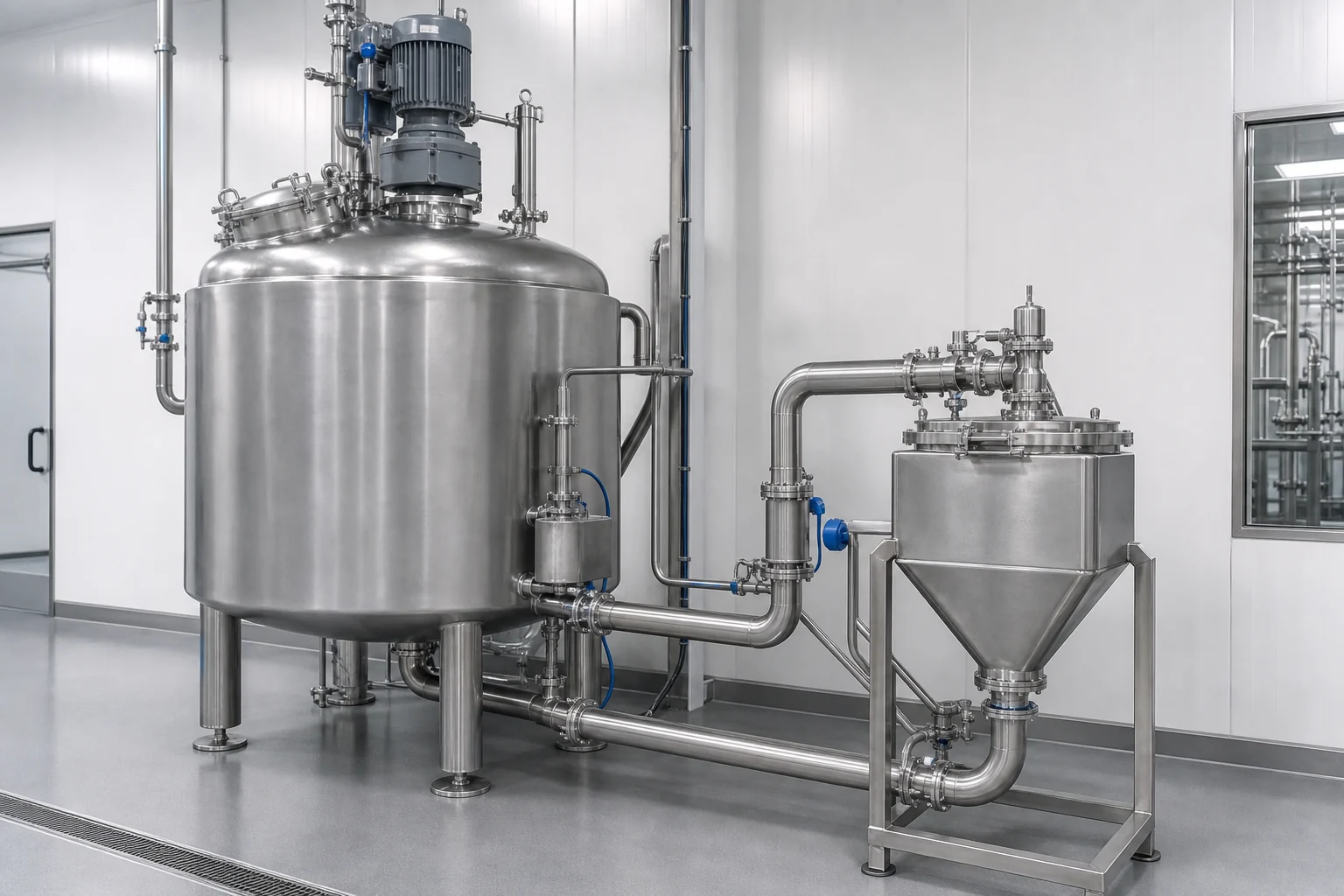
A powder-liquid mixing tank introduces dry ingredients into a liquid phase and provides the circulation needed for wetting, dispersion or dissolution. Powder behaviour, addition rate, temperature and shear requirement determine whether a hopper, eductor, recirculation loop or other induction method is appropriate.
Milk powder, sugar, salt and stabilisers differ in bulk density, solubility, dusting and tendency to form lumps. A reliable process controls how quickly powder reaches the liquid, where it enters and how the batch circulates after addition.
Vessentra develops the tank and induction arrangement around ingredient handling, operator ergonomics, batch order and cleaning. High-shear processing is treated as a separate duty and specified only when the product result requires it.
Typical applications
Application details are reviewed before equipment configuration is finalised.
Engineering configuration
The equipment is developed from process inputs, operating conditions, cleaning requirements and site interfaces.
Bulk density, particle behaviour, solubility, dusting and lumping tendency guide the induction method.
Top loading, closed hopper, eductor or recirculation-based induction is evaluated around batch rate and operator handling.
Agitator and loop flow are selected to wet incoming powder and distribute dissolved material through the vessel.
Hopper, valves, pipework and vessel access are arranged to support cleaning and limit unnecessary open powder handling.
Specification guidance
Project limits are confirmed through engineering review. These fields describe the decisions needed for an accurate, application-specific configuration.
| Process objective | Wetting, dispersion or dissolution |
|---|---|
| Powder addition | Open or closed project-specific arrangement |
| Agitator | Selected for tank circulation and product shear |
| Recirculation | Optional loop and powder induction equipment |
| Product-contact material | Stainless steel selected for compatibility |
| Temperature control | Optional jacket where dissolution requires it |
| Dust management | Coordinated with ingredient handling strategy |
| Cleaning | Manual or CIP-ready configuration |
Common questions
Examples include milk powder, sugar, salt and selected stabilisers. Each ingredient must be reviewed for solubility, dust, lumping, addition rate and any explosion or exposure risk.
Control of powder feed rate, entry point, local liquid velocity, temperature and batch sequence can improve wetting. Some formulations require a dedicated disperser or high-shear device.
No. Readily soluble powders may only need controlled addition and good circulation. High shear should be selected from the required product result, not added by default.
Yes. A closed hopper or induction loop can reduce open handling, subject to powder flow, cleaning, ergonomics and the site dust-control strategy.
Talk to engineering
Share the product, working volume, operating conditions, cleaning method and project location. We will use them to structure the next engineering conversation.