Thermal duty
Starting and target temperatures, batch time, product properties and allowable utility conditions establish the heat-transfer basis.

Mixing with thermal control
A mixing vessel that combines product movement with a project-specific jacket for controlled heating, cooling or temperature maintenance.
Quick answer
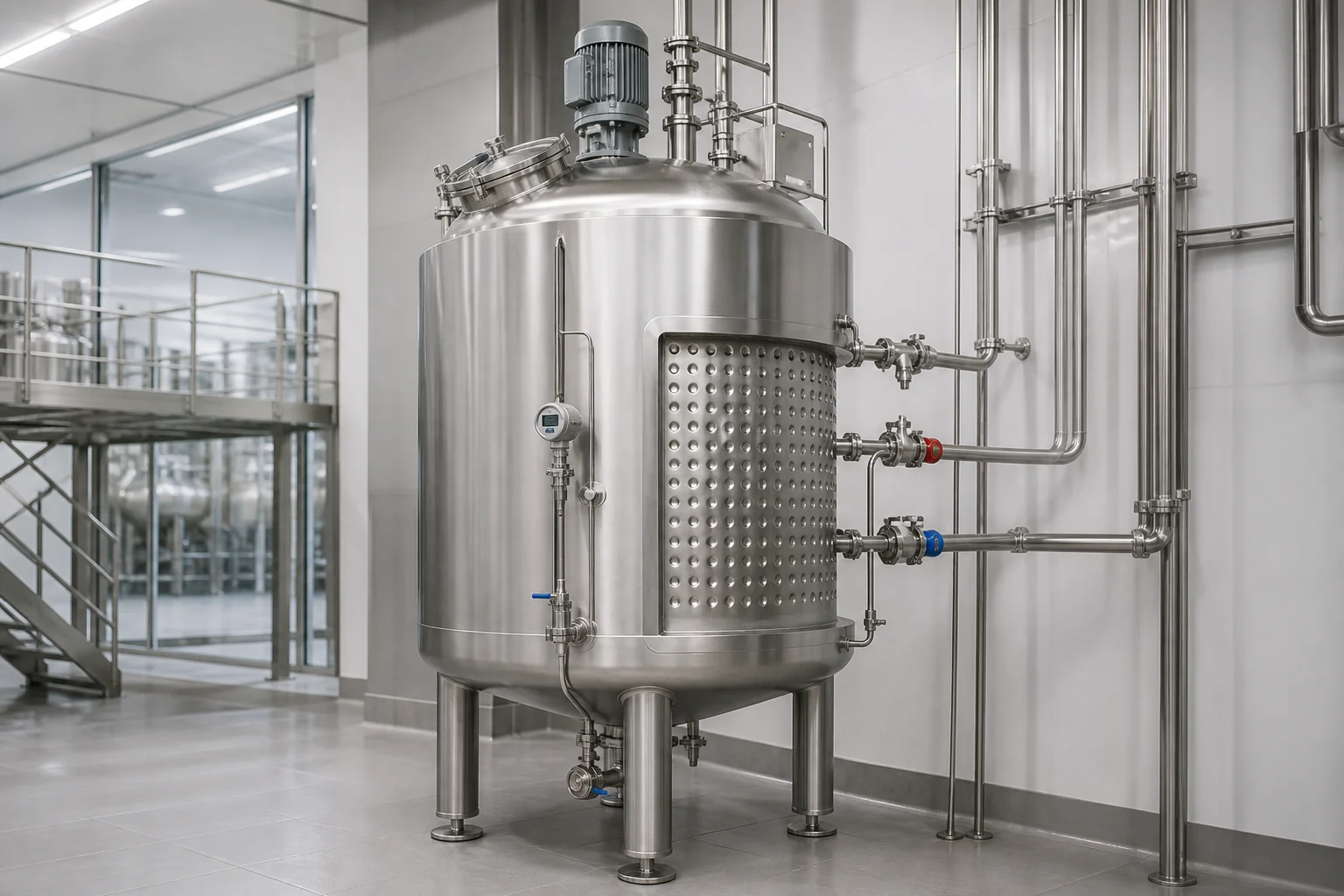
A jacketed stainless steel mixing tank heats, cools or maintains product temperature while an agitator distributes energy through the batch. Jacket selection depends on the thermal duty, utility, operating conditions and vessel design basis.
Mixing and heat transfer are interdependent. Agitation moves product across the heat-transfer surface, while viscosity, temperature change, batch time and utility conditions influence the required jacket arrangement.
Vessentra reviews the product curve and operating sequence before coordinating the jacket, insulation, agitator, temperature instruments and controls. Heating and cooling rates are confirmed from project data rather than treated as fixed catalogue values.
Typical applications
Application details are reviewed before equipment configuration is finalised.
Engineering configuration
The equipment is developed from process inputs, operating conditions, cleaning requirements and site interfaces.
Starting and target temperatures, batch time, product properties and allowable utility conditions establish the heat-transfer basis.
Dimple, half-pipe or other project-appropriate construction is evaluated against pressure, flow and fabrication requirements.
Impeller flow pattern and speed are selected to promote temperature uniformity without applying unnecessary shear.
Insulation, cladding, temperature sensing and control valves can be integrated for stable operation and safer surfaces.
Specification guidance
Project limits are confirmed through engineering review. These fields describe the decisions needed for an accurate, application-specific configuration.
| Thermal function | Heating, cooling or temperature maintenance |
|---|---|
| Utility | Defined from the site thermal system |
| Jacket design | Selected from duty and operating basis |
| Product-contact material | Stainless steel selected for compatibility |
| Agitator | Duty-matched flow and shear profile |
| Insulation | Available with hygienic external cladding |
| Temperature control | Sensor and control options to project scope |
| Cleaning | Manual or CIP-ready configuration |
Common questions
It is used when blending must occur together with heating, cooling or temperature holding, such as syrup preparation, dairy mixing and personal care batches.
The correct choice depends on vessel size, utility, pressure, heat-transfer duty, cycling and applicable fabrication requirements. These inputs should be reviewed before selection.
Not necessarily. Agitation must create suitable circulation, but speed is limited by shear sensitivity, foaming, power demand and mechanical design.
Yes. Insulation thickness and external cladding can be configured around temperature, environment, hygiene and personnel-protection needs.
Talk to engineering
Share the product, working volume, operating conditions, cleaning method and project location. We will use them to structure the next engineering conversation.