Mixing duty
Blend time, uniformity target, product properties and operating levels define the agitator concept.

Versatile hygienic mixing
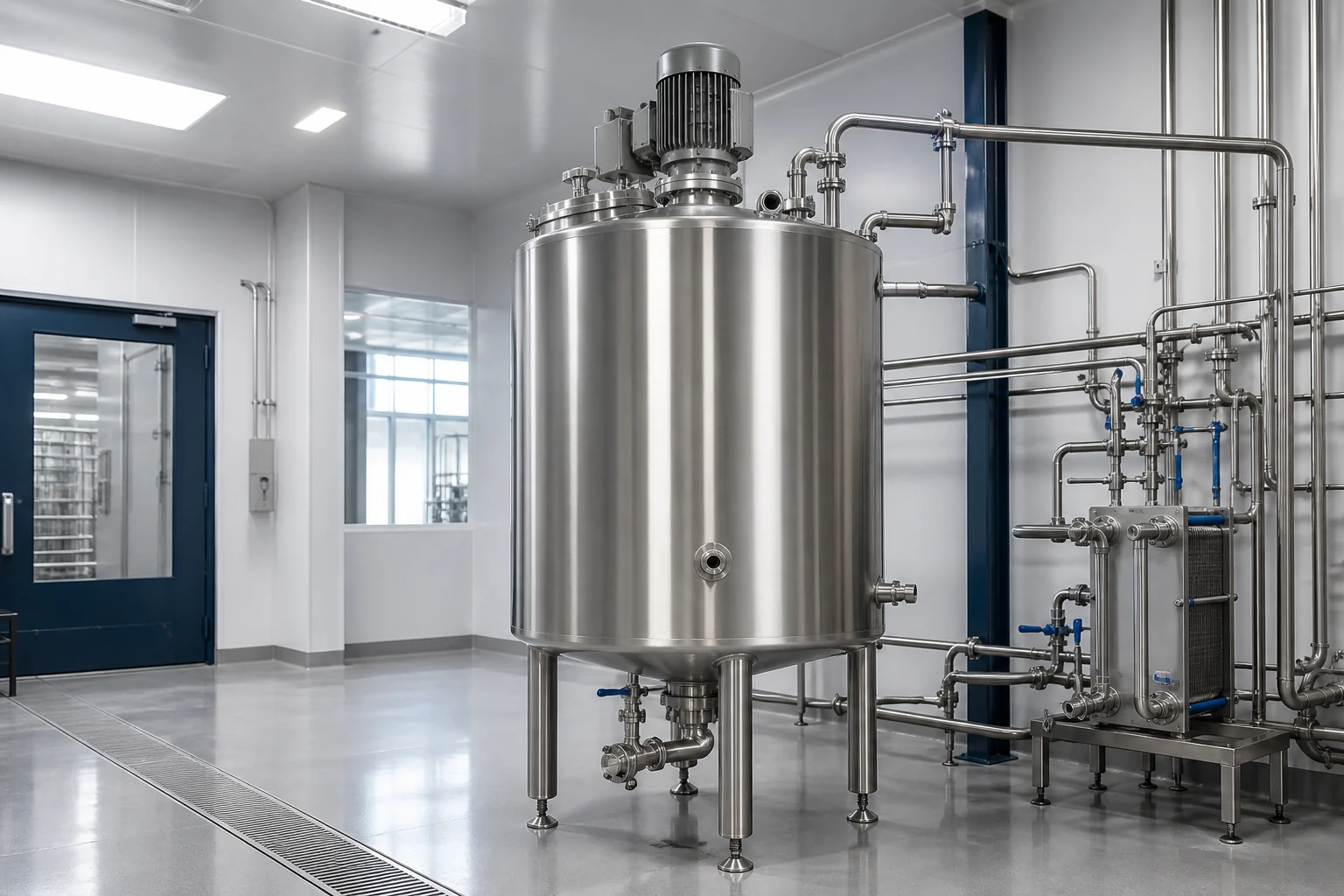
A versatile hygienic mixing vessel configured around product behaviour, batch sequence, cleaning strategy and downstream transfer.
Quick answer
A sanitary stainless steel mixing tank combines a cleanable vessel with an agitator selected for the product and process objective. It can blend liquids, dissolve soluble ingredients, maintain uniformity or keep light solids suspended in hygiene-sensitive production.
Effective mixing starts with the required result: blending to uniformity, dissolving an ingredient, maintaining a suspension or supporting heat transfer. Viscosity, density, batch size, fill level and shear sensitivity guide impeller and drive selection.
Vessentra coordinates the vessel, agitator, baffles, nozzles, instruments and cleaning devices as one process unit. The arrangement is developed for accessible operation, suitable drainability and integration with upstream and downstream equipment.
Typical applications
Application details are reviewed before equipment configuration is finalised.
Engineering configuration
The equipment is developed from process inputs, operating conditions, cleaning requirements and site interfaces.
Blend time, uniformity target, product properties and operating levels define the agitator concept.
Working volume, aspect ratio, headspace, bottom profile and baffles are coordinated with mixing and discharge.
Product-contact fittings, seals, instruments and access points are selected for the cleaning strategy.
Variable-speed control, level indication, pumps and valves can be integrated around the batch sequence.
Specification guidance
Project limits are confirmed through engineering review. These fields describe the decisions needed for an accurate, application-specific configuration.
| Working volume | Sized to batch and operating-level requirements |
|---|---|
| Product-contact material | Stainless steel selected for product and cleaning compatibility |
| Agitator arrangement | Top, bottom or side entry according to duty |
| Impeller type | Selected from viscosity, shear and flow requirements |
| Speed control | Fixed or variable speed as required |
| Internal finish | Hygienic finish defined by application |
| Cleaning | Manual or CIP-ready configuration |
| Instrumentation | Level, temperature and project-specific options |
Common questions
Typical duties include liquid blending, soluble ingredient addition, uniformity maintenance and light solids suspension. The product properties and required result determine the final configuration.
Selection considers viscosity, density, solids, shear sensitivity, batch size, fill range, blend-time target and whether heating or cooling is involved.
Yes. Spray coverage, internal obstructions, seal area, return flow and drainability are reviewed together for a CIP-ready arrangement.
Yes. Nozzle positions, transfer height, utilities, controls and available installation space can be coordinated with existing equipment.
Talk to engineering
Share the product, working volume, operating conditions, cleaning method and project location. We will use them to structure the next engineering conversation.