Impeller system
Axial, radial or combined flow concepts and single or multiple impellers are evaluated from the mixing objective.

Flexible top-mounted agitation
A widely adaptable top-mounted agitator arrangement for liquid blending, solids suspension and batch uniformity across a broad operating range.
Quick answer
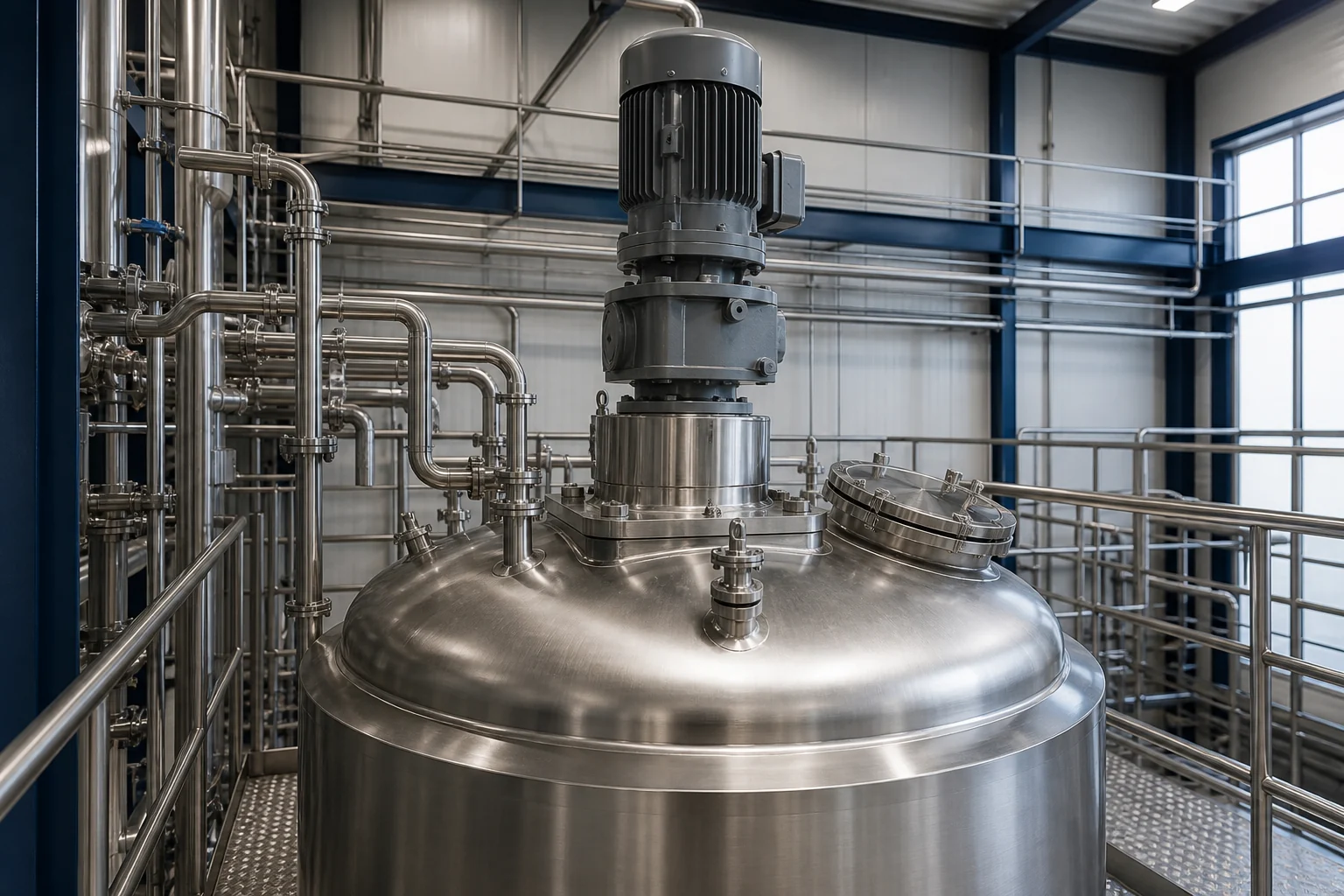
A top-entry agitator mixing tank places the drive above the vessel and transmits power through a vertical shaft to one or more impellers. It is a flexible arrangement for blending, suspension and circulation when headroom and support structure are considered.
Top entry provides broad flexibility in impeller type, shaft length and multi-impeller layouts. The design must account for liquid depth, changing fill level, solids loading, vortex control and the mechanical loads created by the process.
Vessentra selects the drive, shaft, impellers, seal and mounting structure as a coordinated assembly. Maintenance access, lifting space, nozzle conflicts and cleanability are reviewed with the tank layout.
Typical applications
Application details are reviewed before equipment configuration is finalised.
Engineering configuration
The equipment is developed from process inputs, operating conditions, cleaning requirements and site interfaces.
Axial, radial or combined flow concepts and single or multiple impellers are evaluated from the mixing objective.
Motor power, gearbox, speed range and variable-frequency control are selected from calculated process and mechanical loads.
Shaft diameter, coupling, support and tank-top reinforcement are designed as one mechanical system.
Seal type and product-contact geometry are matched to hygiene, pressure, cleaning and maintenance requirements.
Specification guidance
Project limits are confirmed through engineering review. These fields describe the decisions needed for an accurate, application-specific configuration.
| Mounting | Top-entry vertical arrangement |
|---|---|
| Mixing objective | Blending, suspension, circulation or dissolution |
| Impellers | One or more duty-selected impellers |
| Drive | Direct or geared arrangement as required |
| Speed control | Fixed or variable speed |
| Shaft design | Project-specific length and mechanical verification |
| Seal arrangement | Selected for hygiene and operating conditions |
| Vessel integration | Support, baffles and nozzles coordinated with duty |
Common questions
It is often suitable when the process needs flexible impeller selection, deeper liquid circulation, solids suspension or multiple operating levels and adequate overhead access is available.
Many low-viscosity applications benefit from baffles to manage vortexing and improve turnover, but the need and arrangement depend on vessel geometry and impeller selection.
Yes. Multiple impellers may be considered for tall batches or changing liquid levels, subject to process and mechanical design.
Provide vessel dimensions, liquid levels, product properties, mixing objective, available headroom, support constraints, cleaning method and operating conditions.
Talk to engineering
Share the product, working volume, operating conditions, cleaning method and project location. We will use them to structure the next engineering conversation.