Cooling system
Jacket or other thermal surfaces are selected from volume, incoming temperature, target temperature and available utilities.

Dairy holding and cooling
A hygienic dairy vessel for receiving, cooling, holding and transferring milk while protecting temperature and product uniformity.
Quick answer
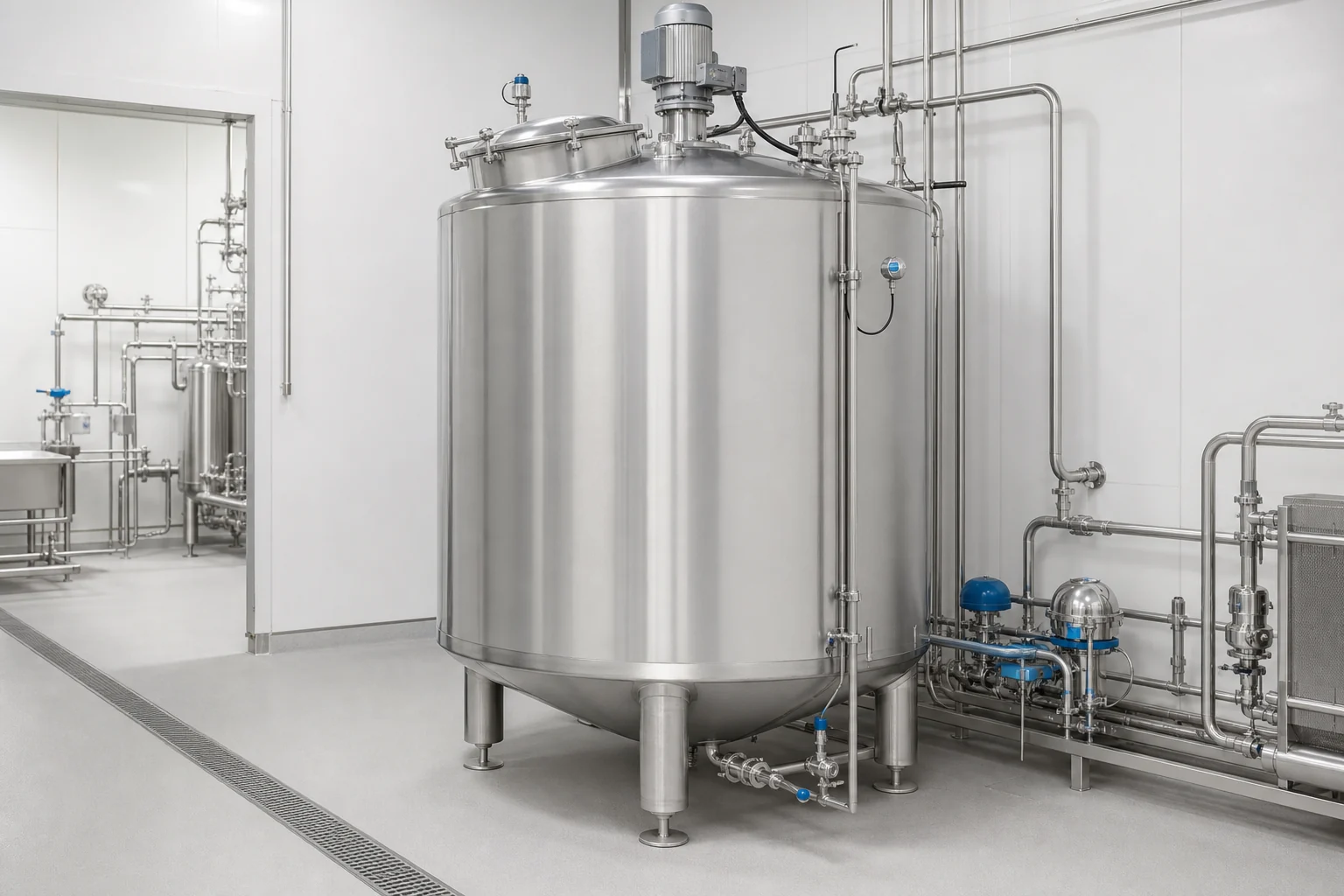
A stainless steel milk storage tank holds raw or processed milk under controlled hygienic conditions. Cooling, insulation and gentle agitation may be incorporated to maintain temperature and uniformity without unnecessarily damaging the product.
Milk storage performance depends on receiving temperature, holding time, required cooling rate, agitation method and the downstream process. The vessel must support sanitation while avoiding difficult-to-clean zones and excessive product treatment.
Vessentra configures the tank for dairy transfer, temperature monitoring, gentle mixing and CIP integration, with the thermal system selected from the site utilities and cooling duty.
Typical applications
Application details are reviewed before equipment configuration is finalised.
Engineering configuration
The equipment is developed from process inputs, operating conditions, cleaning requirements and site interfaces.
Jacket or other thermal surfaces are selected from volume, incoming temperature, target temperature and available utilities.
Mixer speed and impeller arrangement are selected to maintain uniformity while respecting product sensitivity.
Insulation and outer cladding reduce heat gain and support hygienic external cleaning in the dairy environment.
Receiving, transfer, sampling, temperature and CIP interfaces are arranged around plant flow and operator access.
Specification guidance
Project limits are confirmed through engineering review. These fields describe the decisions needed for an accurate, application-specific configuration.
| Product duty | Raw or processed dairy liquid holding |
|---|---|
| Working volume | Sized from receiving and production schedule |
| Product-contact material | Dairy-compatible stainless steel |
| Thermal configuration | Insulated with cooling options |
| Agitation | Gentle application-specific mixer where required |
| Cleaning | CIP-ready configuration available |
| Temperature measurement | Hygienic sensor and control options |
| Transfer | Outlet and pump interface matched to dairy line |
Common questions
Cooling is required when the process specification calls for chilled holding. The thermal design depends on incoming temperature, target temperature, volume, hold time and site utilities.
Appropriate agitation helps maintain temperature and product uniformity. Mixer selection should limit unnecessary air incorporation, foaming and mechanical stress.
Potentially, but cream has different viscosity and handling behaviour. The outlet, agitation and cleaning arrangement should be checked for each intended product.
Yes. Available flow, pressure, cleaning chemistry, return arrangement and spray-device coverage must be reviewed before final design.
Talk to engineering
Share the product, working volume, operating conditions, cleaning method and project location. We will use them to structure the next engineering conversation.