Heat-duty review
Product mass, specific heat, starting and target temperatures, cycle time and heat loss establish the thermal requirement.

Active temperature control
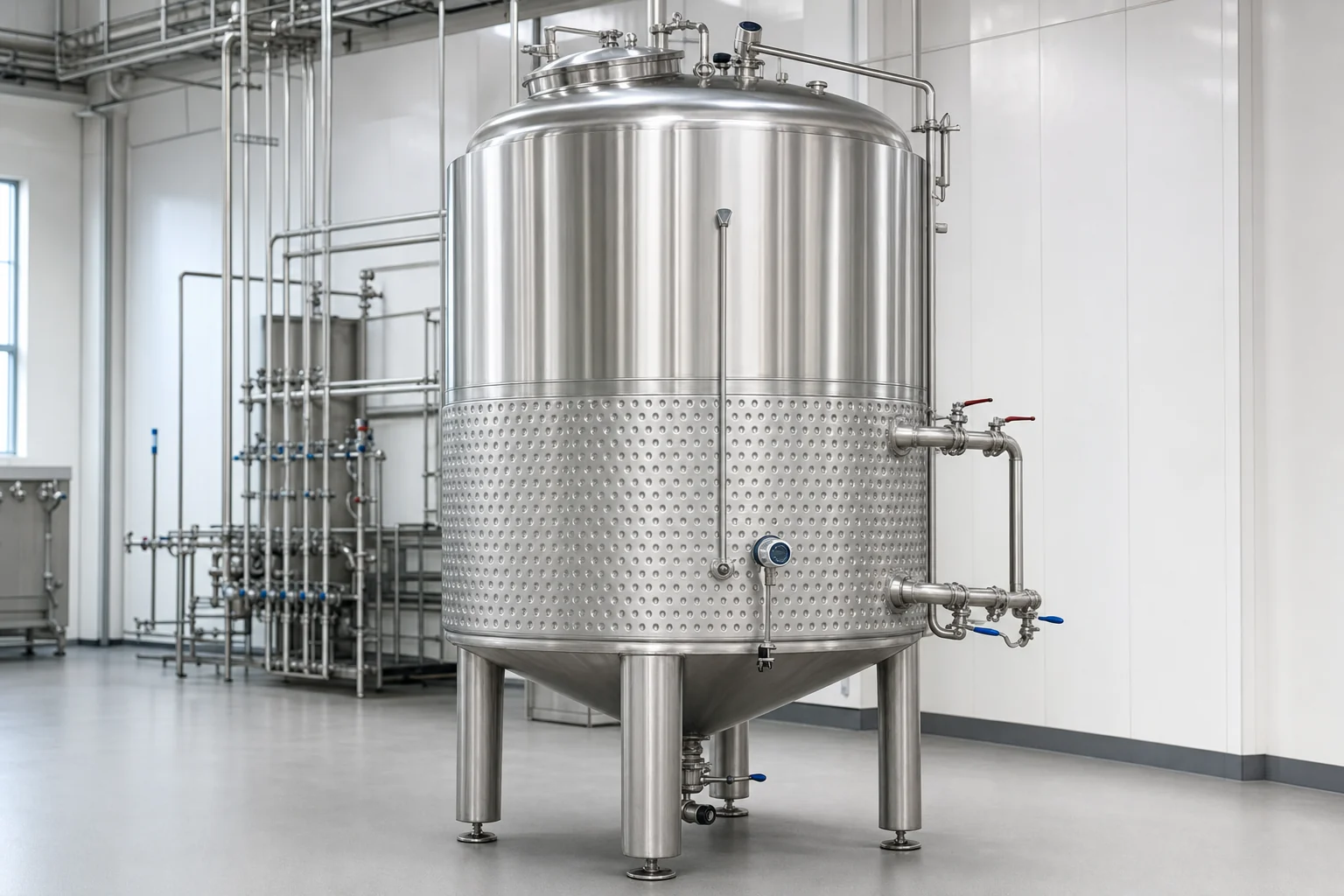
A hygienic holding vessel with an integrated thermal jacket for product heating, cooling or controlled temperature maintenance.
Quick answer
A jacketed stainless steel storage tank circulates a heating or cooling medium around the product vessel to manage temperature during holding. Jacket type, area and controls are selected from the product properties, heat duty, utility conditions and allowable temperature change.
Adding a jacket does not by itself guarantee effective temperature control. Product viscosity, natural or forced circulation, jacket coverage, utility temperature and insulation determine real thermal performance.
Vessentra reviews the complete heat balance and can coordinate agitation, temperature sensors, control valves and insulation with the tank design. The jacket operating envelope is defined separately from the product side.
Typical applications
Application details are reviewed before equipment configuration is finalised.
Engineering configuration
The equipment is developed from process inputs, operating conditions, cleaning requirements and site interfaces.
Product mass, specific heat, starting and target temperatures, cycle time and heat loss establish the thermal requirement.
Jacket arrangement and coverage are selected around utility pressure, flow, temperature and vessel geometry.
Agitation or recirculation can be considered when uniform temperature or improved heat transfer is required.
Temperature sensors, valves and control logic can be integrated for heating, cooling or maintenance modes.
Specification guidance
Project limits are confirmed through engineering review. These fields describe the decisions needed for an accurate, application-specific configuration.
| Thermal duty | Heating, cooling or temperature maintenance |
|---|---|
| Product-contact material | Selected for hygienic product compatibility |
| Jacket design | Configured to utility and heat-duty requirements |
| Insulation | Available to reduce heat gain or loss |
| Product movement | Static, recirculated or agitated options |
| Temperature control | Sensor, valve and control options |
| Cleaning | Manual or CIP-ready product side |
| Operating limits | Defined separately for vessel and jacket |
Common questions
It may be possible when the utility system, control arrangement and operating sequence support both modes. Cross-contamination and thermal-shock risks must also be reviewed.
Not always, but agitation or recirculation can improve temperature uniformity and heat transfer, especially for viscous or slow-moving products.
Provide product properties, volume, initial and target temperatures, required time, utility medium, utility conditions, ambient conditions and vessel operating mode.
Yes. Insulation is commonly considered when the vessel must minimise heat loss, heat gain or external surface temperature.
Talk to engineering
Share the product, working volume, operating conditions, cleaning method and project location. We will use them to structure the next engineering conversation.