Thermal objective
Holding temperature, acceptable change, duration and ambient conditions define the insulation requirement.

Passive temperature stability
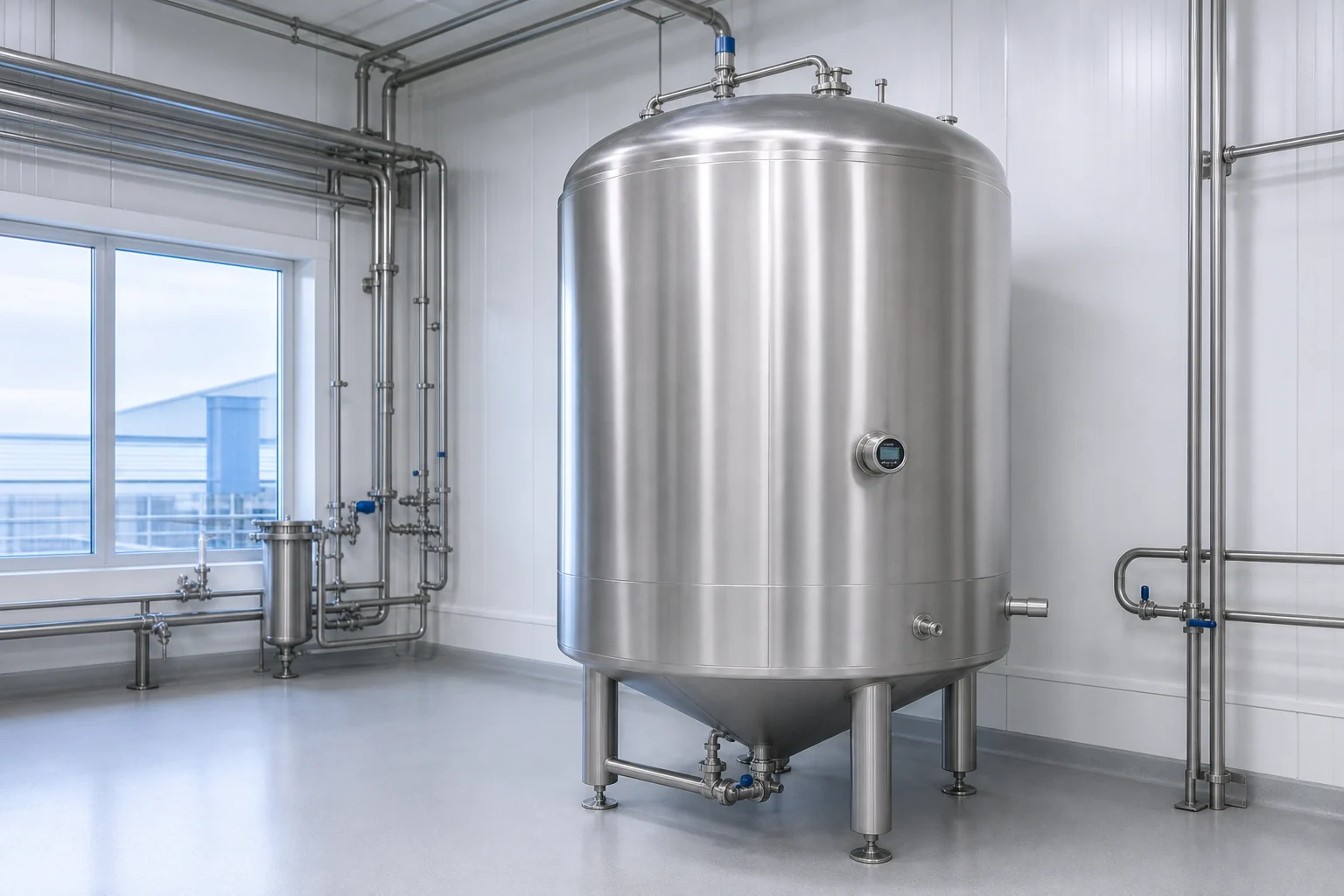
A hygienic storage vessel with thermal insulation for reducing heat gain or loss during controlled liquid holding.
Quick answer
An insulated sanitary storage tank slows product temperature change by adding a thermal barrier and protective outer cladding around the vessel. It is suited to holding duties that need better temperature stability but do not necessarily require active heating or cooling.
Insulation performance is influenced by the temperature difference, hold time, tank surface area, ambient conditions and thermal bridges at supports and connections. The correct construction therefore starts with the expected operating environment.
Vessentra selects insulation and hygienic external cladding around the thermal objective, cleaning conditions and installation location. A jacket can be added separately when active temperature control is required.
Typical applications
Application details are reviewed before equipment configuration is finalised.
Engineering configuration
The equipment is developed from process inputs, operating conditions, cleaning requirements and site interfaces.
Holding temperature, acceptable change, duration and ambient conditions define the insulation requirement.
Material and thickness are selected around thermal performance, moisture exposure and installation constraints.
Protective stainless steel cladding can provide a durable, cleanable surface for hygienic production areas.
Cold service details are developed to reduce moisture ingress and manage condensation around penetrations.
Specification guidance
Project limits are confirmed through engineering review. These fields describe the decisions needed for an accurate, application-specific configuration.
| Thermal function | Reduced heat gain or heat loss |
|---|---|
| Insulation type | Selected for temperature and environment |
| Outer cladding | Cleanable stainless steel option |
| Product-contact material | Selected for process compatibility |
| Installation | Indoor or project-reviewed outdoor arrangement |
| Active temperature duty | Optional separate heating or cooling jacket |
| Cleaning | Manual or CIP-ready product side |
| Penetration details | Developed to manage thermal bridging and moisture |
Common questions
Insulation slows heat transfer between the product and surroundings. A jacket actively adds or removes heat using a circulating utility medium. A vessel can include both.
Insulation reduces temperature change but does not actively correct it. Exact control normally requires a heating or cooling system and suitable controls.
It can be designed for the stated environment, but weather exposure, wind, moisture sealing, supports and local conditions must be included in the project basis.
Selection considers product temperature, ambient range, allowable heat gain or loss, hold time, surface area, condensation risk and installation requirements.
Talk to engineering
Share the product, working volume, operating conditions, cleaning method and project location. We will use them to structure the next engineering conversation.