Support arrangement
Saddles, frames, anchors and local shell loads are developed for operating, empty and installation conditions.

Low-profile hygienic storage
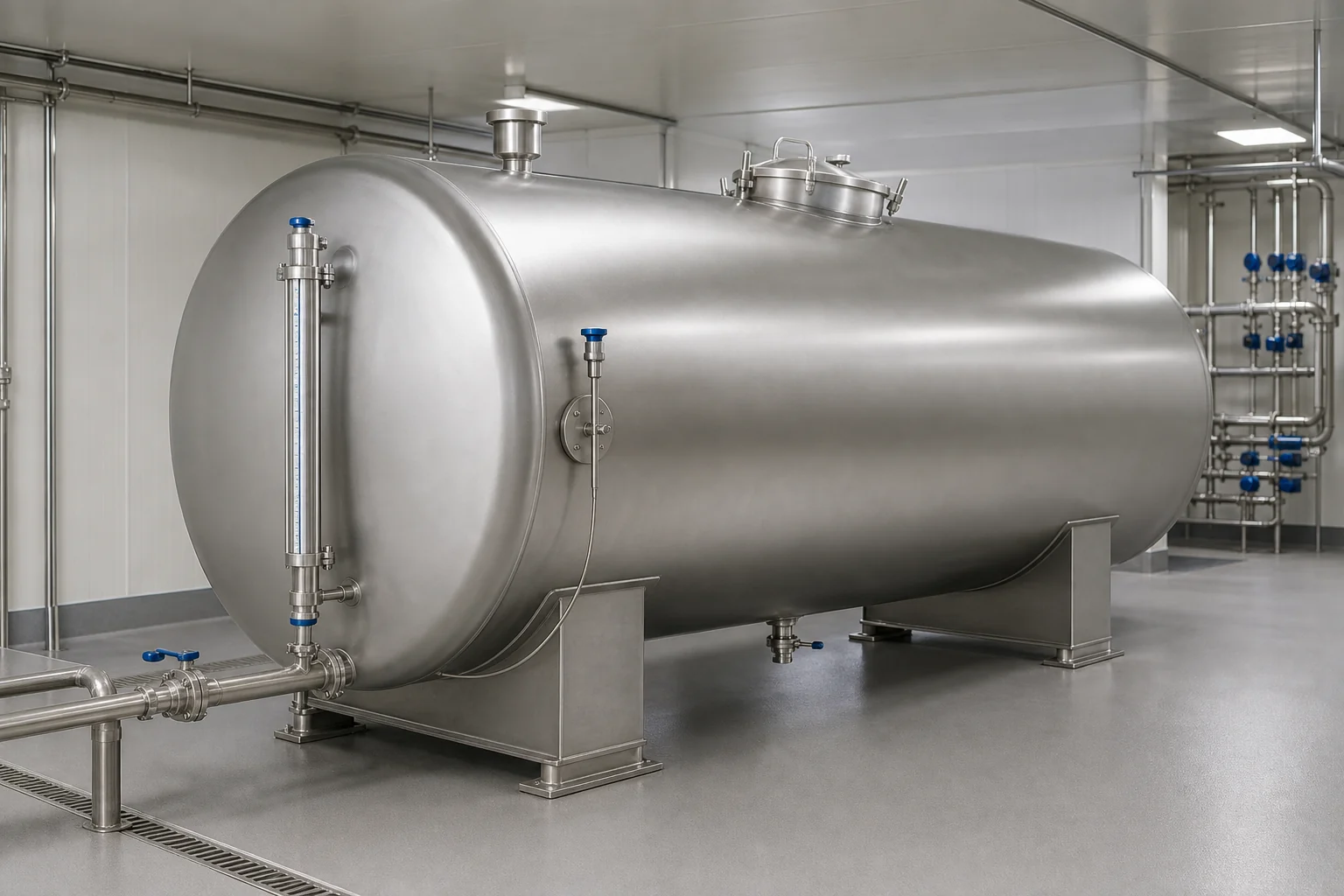
A low-profile stainless steel vessel for hygienic storage where building height, transport or installation geometry favours a horizontal arrangement.
Quick answer
A horizontal stainless steel storage tank places the cylindrical shell on engineered supports to reduce overall installation height. It can suit low-clearance or large-volume layouts, but drainage, support loads, access and cleaning coverage require careful design.
Horizontal orientation changes liquid level behaviour, structural support and the way the vessel drains and cleans. Nozzle positions and instrument selection must reflect the variable cross-sectional area over the working level.
Vessentra coordinates saddles or support frames, bottom slope, access, lifting, transport constraints and sanitary process connections with the final installation layout.
Typical applications
Application details are reviewed before equipment configuration is finalised.
Engineering configuration
The equipment is developed from process inputs, operating conditions, cleaning requirements and site interfaces.
Saddles, frames, anchors and local shell loads are developed for operating, empty and installation conditions.
Tank slope, outlet location and internal profile are coordinated to limit product retention and support cleaning.
Instrument selection accounts for the nonlinear volume-to-level relationship of a horizontal cylinder.
Transport route, lifting points, access clearances and installation sequence are considered during mechanical layout.
Specification guidance
Project limits are confirmed through engineering review. These fields describe the decisions needed for an accurate, application-specific configuration.
| Orientation | Horizontal cylindrical vessel |
|---|---|
| Working volume | Project-sized to storage requirement |
| Product-contact material | Hygienic stainless steel selected by duty |
| Supports | Saddles or frame engineered for installation |
| Drainage | Slope and outlet arrangement reviewed by application |
| Cleaning | Manual or CIP-ready configuration |
| Instrumentation | Level and temperature options for orientation |
| Installation review | Access, lifting and transport coordination |
Common questions
A horizontal arrangement can help when installation height, building access, transport or process layout makes a vertical vessel impractical.
Drainability can be improved through slope, outlet placement and internal geometry, but the required drainage standard must be defined and engineered for the product and cleaning method.
Several instruments can be used, but conversion from level to volume must account for the changing cross-sectional area of the horizontal cylinder.
Yes. Thermal construction can be added when the heat duty, support penetrations, external finish and installation constraints are included in the design.
Talk to engineering
Share the product, working volume, operating conditions, cleaning method and project location. We will use them to structure the next engineering conversation.