Phase preparation
Oil- and water-phase vessels, heating and addition paths are configured around the recipe and required phase condition at transfer.

Closed vacuum emulsification
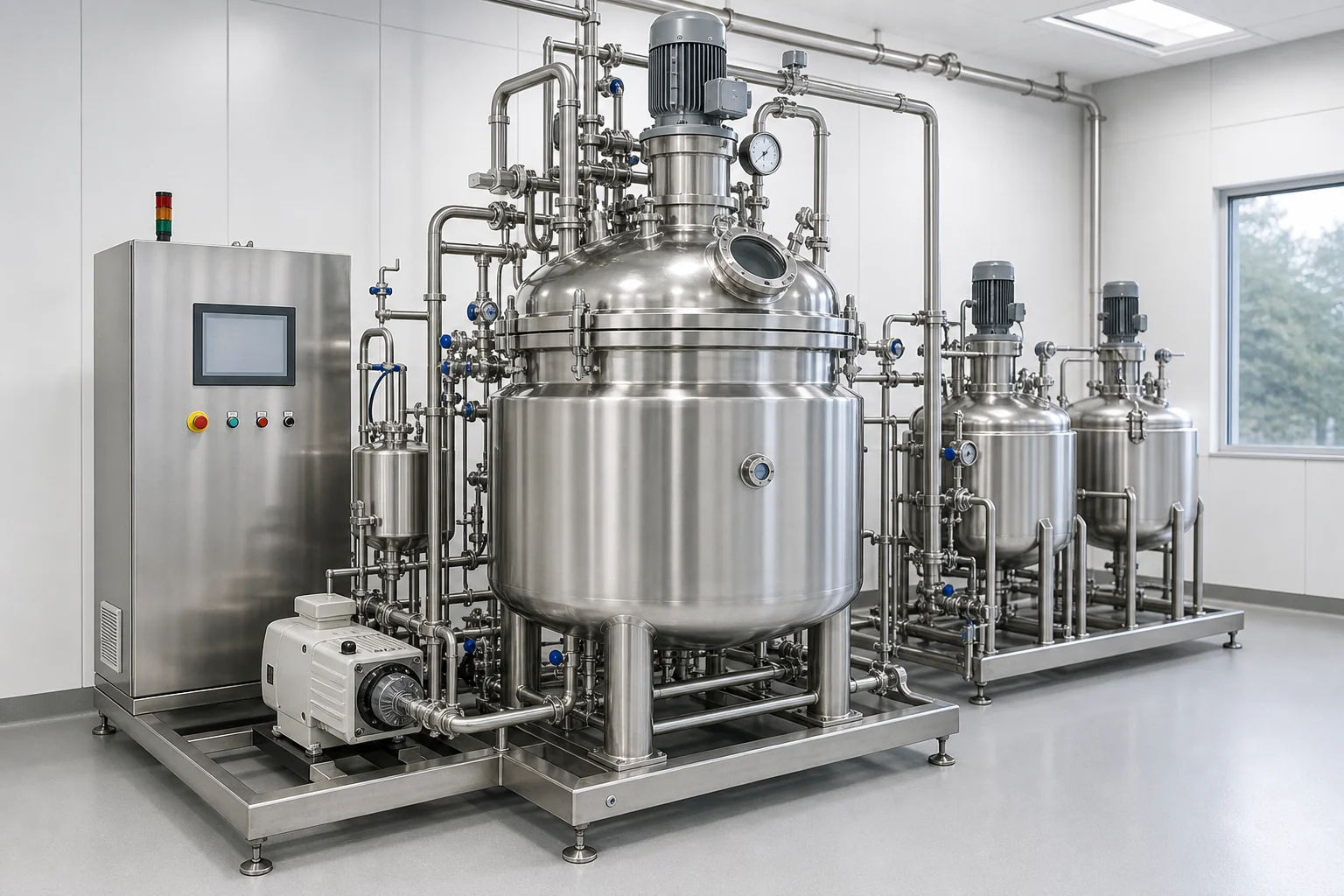
A closed emulsification vessel combining vacuum deaeration, high-shear homogenization, bulk agitation and controlled heating or cooling.
Quick answer
A vacuum homogenizing emulsifying tank processes oil and water phases in a sealed vessel using high shear, controlled bulk movement and reduced pressure. Vacuum can remove entrained air and support product appearance, density and filling behavior when the formulation and temperature profile are suitable.
Creams, lotions and ointments often change viscosity as phases combine and cool. The homogenizer must work with the anchor or wall-sweeping agitator so the complete batch reaches the shear zone without localized overheating or uncontrolled air incorporation.
Vessentra coordinates the main vessel with phase-preparation tanks, vacuum generation, condensation or pump protection, jacket utilities, transfer equipment and controls. Volatile ingredients, foaming tendency and maximum vacuum are reviewed before the operating sequence is defined.
Typical applications
Application details are reviewed before equipment configuration is finalised.
Engineering configuration
The equipment is developed from process inputs, operating conditions, cleaning requirements and site interfaces.
Oil- and water-phase vessels, heating and addition paths are configured around the recipe and required phase condition at transfer.
Vacuum level, pump type, condensate handling and safeguards are selected from vapour load, foaming and volatile ingredients.
High-shear homogenization works with anchor, frame or wall-sweeping agitation as viscosity changes through emulsification and cooling.
Temperature, speed, vacuum, addition steps and hold times can be coordinated through a documented batch sequence.
Specification guidance
Project limits are confirmed through engineering review. These fields describe the decisions needed for an accurate, application-specific configuration.
| Process system | Closed vacuum emulsification and homogenization |
|---|---|
| Working volume | Project-sized for pilot or production batches |
| High-shear mixer | Duty-selected rotor-stator homogenizer |
| Bulk agitation | Anchor, frame or wall-sweeping option |
| Vacuum envelope | Defined from product, vessel and vapour-handling requirements |
| Thermal control | Jacketed heating, holding and controlled cooling |
| Phase preparation | Optional oil- and water-phase premix vessels |
| Automation | Local HMI or recipe-based control integration |
Common questions
It is commonly used for creams, lotions, ointments and other formulations that need controlled phase combination, high-shear homogenization, temperature management and removal of entrained air.
No. The rotor-stator mixer and formulation chemistry create and refine the emulsion. Vacuum manages the vessel atmosphere and can assist deaeration, controlled transfer or oxygen exposure when the process is designed for it.
The homogenizer provides intense local shear, while the anchor or wall-sweeping agitator moves viscous material through the whole vessel, supports heat transfer and returns product to the high-shear zone.
Not always. They are useful when phases need independent heating, dissolution or timed transfer. The number and size of preparation vessels should follow the actual recipe and production schedule.
Vapour pressure, product temperature, vacuum level, condenser or pump protection, ingredient losses and safe vent handling must be reviewed before the batch sequence is approved.
Talk to engineering
Share the product, working volume, operating conditions, cleaning method and project location. We will use them to structure the next engineering conversation.