Shear objective
Required wetting, deagglomeration, droplet-size reduction or homogenization result is defined before mixer geometry and speed are selected.

Versatile hygienic emulsification
An integrated sanitary vessel for high-shear mixing, fine dispersion and repeatable emulsification across hygienic batch processes.
Quick answer
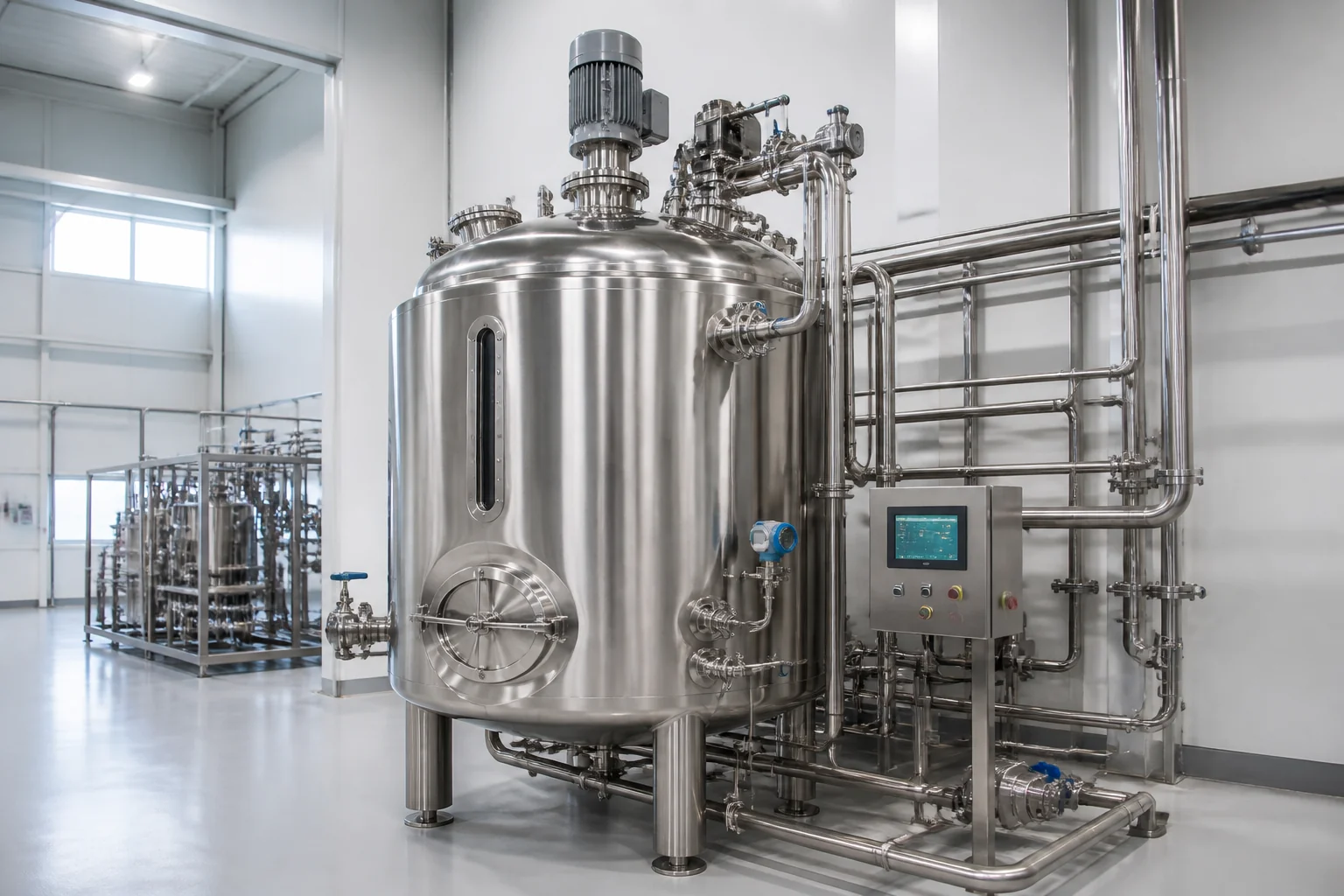
A sanitary high-shear emulsifying tank combines a hygienic process vessel with a rotor-stator mixer and supporting bulk agitation. It is used to disperse, homogenize or emulsify ingredients when ordinary low-shear blending cannot deliver the required texture, stability or particle distribution.
High shear is one part of the process. Phase ratio, addition order, temperature, viscosity and residence time determine how effectively material passes through the rotor-stator zone and how much energy the formulation receives.
Vessentra coordinates the vessel geometry, high-shear mixer, bulk agitator, jacket, addition points, instrumentation and cleaning provisions as one process unit. The selected arrangement is verified against the full batch range, not only the maximum working volume.
Typical applications
Application details are reviewed before equipment configuration is finalised.
Engineering configuration
The equipment is developed from process inputs, operating conditions, cleaning requirements and site interfaces.
Required wetting, deagglomeration, droplet-size reduction or homogenization result is defined before mixer geometry and speed are selected.
Anchor, paddle or other duty-selected agitation moves the complete batch through the high-shear zone and supports uniform temperature.
Jacket zones, utilities and control response are evaluated against heating, hold, emulsification and cooling steps.
Product-contact finish, drainability, seals, nozzles and spray coverage are developed around the cleaning strategy.
Specification guidance
Project limits are confirmed through engineering review. These fields describe the decisions needed for an accurate, application-specific configuration.
| Process duty | Emulsification, dispersion, wetting or homogenization |
|---|---|
| Working volume | Project-sized for minimum and maximum batch levels |
| High-shear mixer | Rotor-stator system selected from formulation duty |
| Bulk agitation | Duty-selected impeller with variable-speed option |
| Product-contact material | Stainless steel selected for product and cleaning compatibility |
| Thermal control | Optional jacket, insulation and temperature instrumentation |
| Cleaning | Manual or CIP-ready hygienic configuration |
| Controls | Local control or recipe-sequence integration |
Common questions
It applies concentrated mechanical shear through a rotor-stator mixer while the vessel and bulk agitator manage the complete batch. The system can support emulsification, fine dispersion, powder wetting or homogenization when correctly matched to the formulation.
A standard agitator primarily circulates and blends the vessel contents. A high-shear mixer creates an intense local processing zone for droplet or agglomerate reduction, while complementary agitation returns material to that zone.
It can be designed for a defined batch range, but minimum liquid coverage, mixer position, agitator flow and heat-transfer performance must be checked at every intended operating level.
Provide ingredient phases, batch range, viscosity profile, addition order, temperature cycle, target texture or particle result, current process time, cleaning method and downstream transfer requirements.
Talk to engineering
Share the product, working volume, operating conditions, cleaning method and project location. We will use them to structure the next engineering conversation.