Bottom-head geometry
Mixer centerline, outlet, slope and impeller clearance are coordinated to support drainability and avoid mechanical conflicts.

Direct bottom-zone homogenization
A bottom-mounted rotor-stator system that places high-shear processing close to the vessel outlet and main product circulation path.
Quick answer
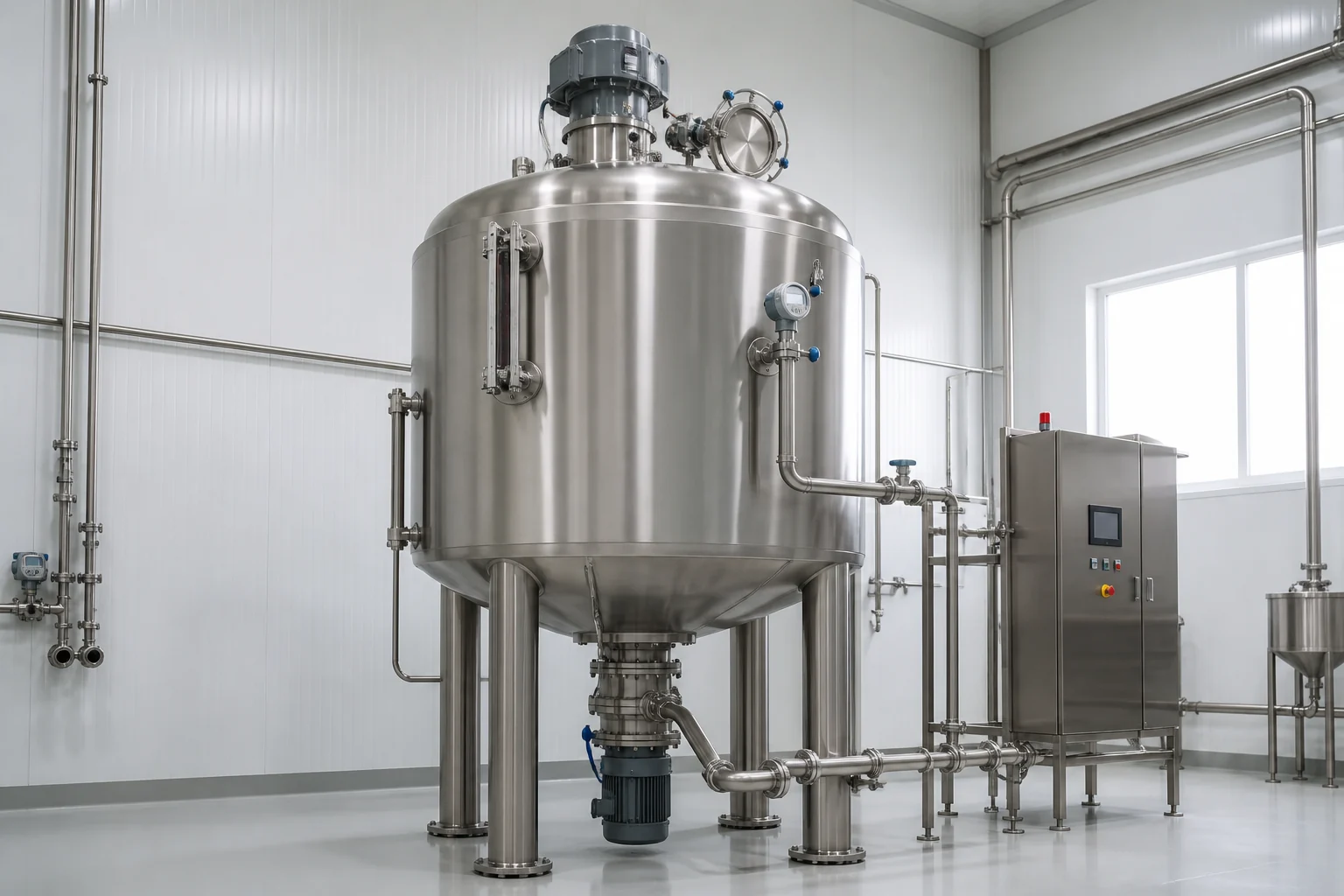
A bottom-entry high-shear emulsifying tank positions the rotor-stator mixer at the lowest processing zone of the vessel. This arrangement can improve access to the batch at reduced liquid levels, shorten the product path to the mixer and support strong bottom-to-top circulation when paired with suitable bulk agitation.
Bottom entry can be valuable where top-mounted equipment space is limited or the process benefits from direct shear near the discharge zone. Performance still depends on impeller coverage, vessel profile, viscosity and the way the bulk flow returns material to the mixer.
Vessentra develops the bottom head, mixer mounting, mechanical seal, drain outlet, support frame and maintenance clearance together. The installation is checked for mixer loads, hygienic access and safe removal of the drive or wet-end components.
Typical applications
Application details are reviewed before equipment configuration is finalised.
Engineering configuration
The equipment is developed from process inputs, operating conditions, cleaning requirements and site interfaces.
Mixer centerline, outlet, slope and impeller clearance are coordinated to support drainability and avoid mechanical conflicts.
Head geometry, speed, power and optional stages are selected from viscosity, solids and the required dispersion or emulsion result.
Bulk agitation and any external loop are arranged to return the complete batch to the bottom processing zone.
Seal type, flush strategy, lifting clearance and removal path are planned around hygiene, operating conditions and site access.
Specification guidance
Project limits are confirmed through engineering review. These fields describe the decisions needed for an accurate, application-specific configuration.
| Mixer position | Bottom-entry rotor-stator arrangement |
|---|---|
| Process duty | High-shear dispersion, emulsification or homogenization |
| Batch range | Verified against mixer coverage and vessel circulation |
| Bulk agitation | Optional complementary top-entry system |
| Product-contact material | Stainless steel selected for process compatibility |
| Seal arrangement | Hygienic mechanical seal selected for operating conditions |
| Vessel bottom | Drainable geometry coordinated with mixer and outlet |
| Speed control | Variable-speed control available to process requirements |
Common questions
Bottom mounting gives the mixer direct access to the lowest product zone and can reduce the flow path between the vessel and rotor-stator head. It may also help at reduced batch levels when the mixer remains correctly covered.
No mixer position guarantees complete turnover by itself. Vessel geometry, viscosity, batch level and complementary agitation must be evaluated together to control slow-moving zones.
It may support wetting and deagglomeration after powder reaches the liquid, but the feed point, addition rate, dust control and tendency to form floating rafts must be addressed in the complete process design.
The layout must provide clearance for the motor, seal, wet-end removal and safe maintenance. Floor, platform or skid geometry is finalized around the selected mixer and lifting method.
Talk to engineering
Share the product, working volume, operating conditions, cleaning method and project location. We will use them to structure the next engineering conversation.