Ingredient sequence
Surfactants, thickeners, oils, fragrances and sensitive additions are assigned suitable entry points and batch stages.

Flexible personal care formulation
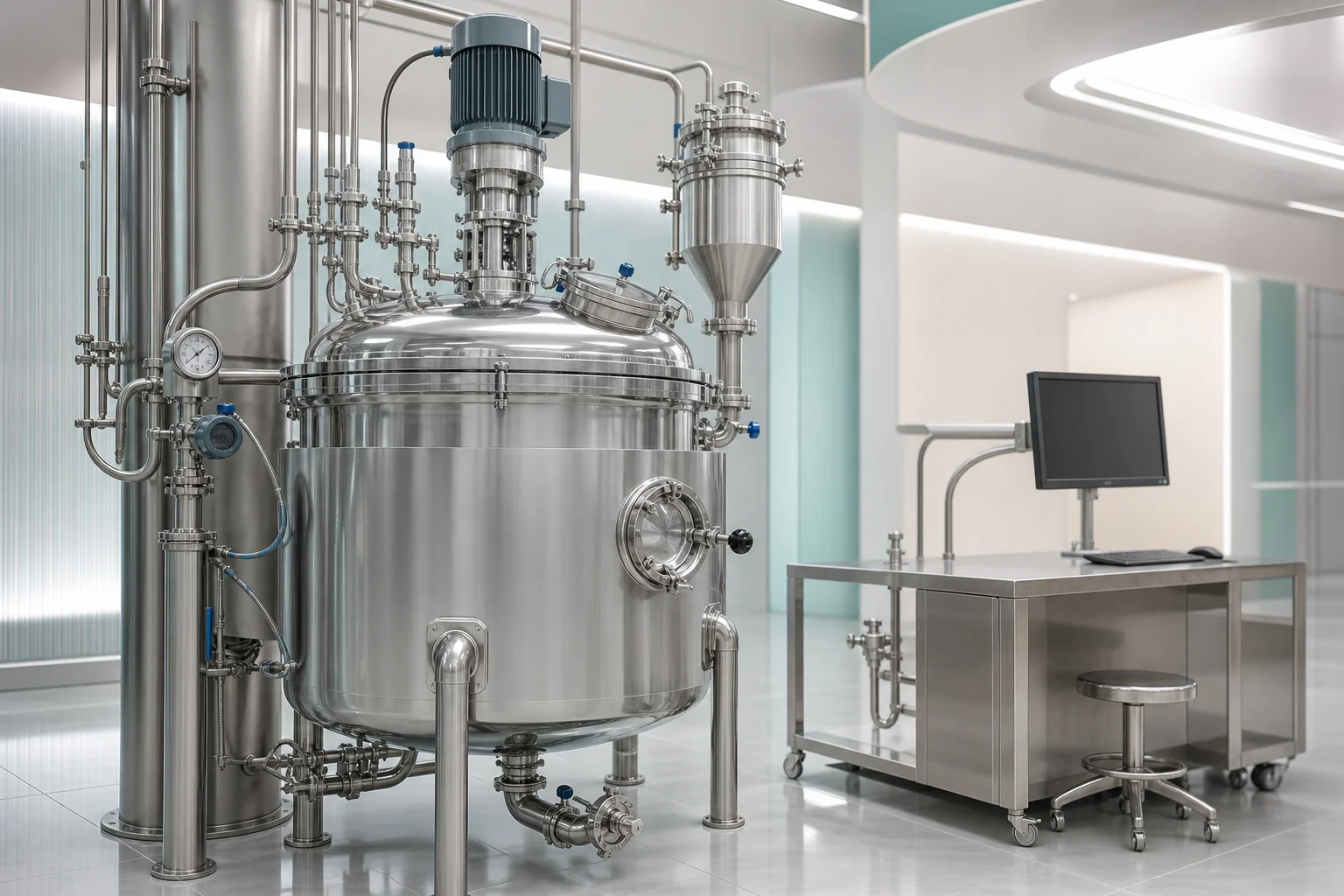
A flexible formulation vessel for shampoos, lotions, gels and personal care liquids, configured around ingredient sequence, viscosity and air management.
Quick answer
A cosmetic and personal care compounding tank prepares products such as shampoos, lotions, gels and cleansers through controlled ingredient addition, mixing and temperature management. Agitation and air-handling options are selected for the formulation and desired product appearance.
Personal care recipes can include surfactants, thickeners, fragrances, oils, colours and sensitive active ingredients. Addition sequence and local mixing conditions influence hydration, foaming, viscosity and batch consistency.
Vessentra configures the vessel around the product family and changeover strategy. Gentle bulk mixing, wall sweeping, vacuum, heating, cooling, load cells and dedicated addition points can be combined where the process requires them.
Typical applications
Application details are reviewed before equipment configuration is finalised.
Engineering configuration
The equipment is developed from process inputs, operating conditions, cleaning requirements and site interfaces.
Surfactants, thickeners, oils, fragrances and sensitive additions are assigned suitable entry points and batch stages.
Impeller flow, speed and submerged addition can be selected to achieve uniformity while managing unwanted air incorporation.
Bulk agitation, wall movement, temperature and hydration time are coordinated through the expected rheology range.
Connections, cleaning devices and controls can be arranged for recipe changeovers and multiple compatible products.
Specification guidance
Project limits are confirmed through engineering review. These fields describe the decisions needed for an accurate, application-specific configuration.
| Product range | Shampoos, cleansers, lotions, gels and compatible formulations |
|---|---|
| Agitation | Gentle, anchor, frame or combined project-specific option |
| Ingredient addition | Liquid and powder interfaces to recipe needs |
| Air management | Low-foam addition or optional vacuum configuration |
| Thermal control | Optional jacket and insulation |
| Weighing | Optional load-cell integration |
| Discharge | Configured for finished viscosity and filling connection |
| Cleaning | Manual or CIP-ready changeover strategy |
Common questions
It may be possible, but viscosity range, mixing needs, allergen or ingredient segregation, cleaning validation and changeover time must be reviewed for every intended recipe.
Suitable addition points, submerged charging, controlled agitator speed and batch sequence can reduce unnecessary air entry. Vacuum may be evaluated when the formulation permits.
Yes. Dedicated addition points and sequence controls can support late additions after cooling or other defined process steps.
Not for every personal care product. It should be selected only when the formulation needs dispersion or emulsification beyond the capability of bulk agitation.
Talk to engineering
Share the product, working volume, operating conditions, cleaning method and project location. We will use them to structure the next engineering conversation.