Rheology and torque
Viscosity range, yield behaviour, temperature and batch level establish the agitator and drive basis.

Controlled viscous batch processing
A robust compounding vessel for viscous formulations requiring controlled bulk movement, wall sweeping, heat transfer and dependable discharge.
Quick answer
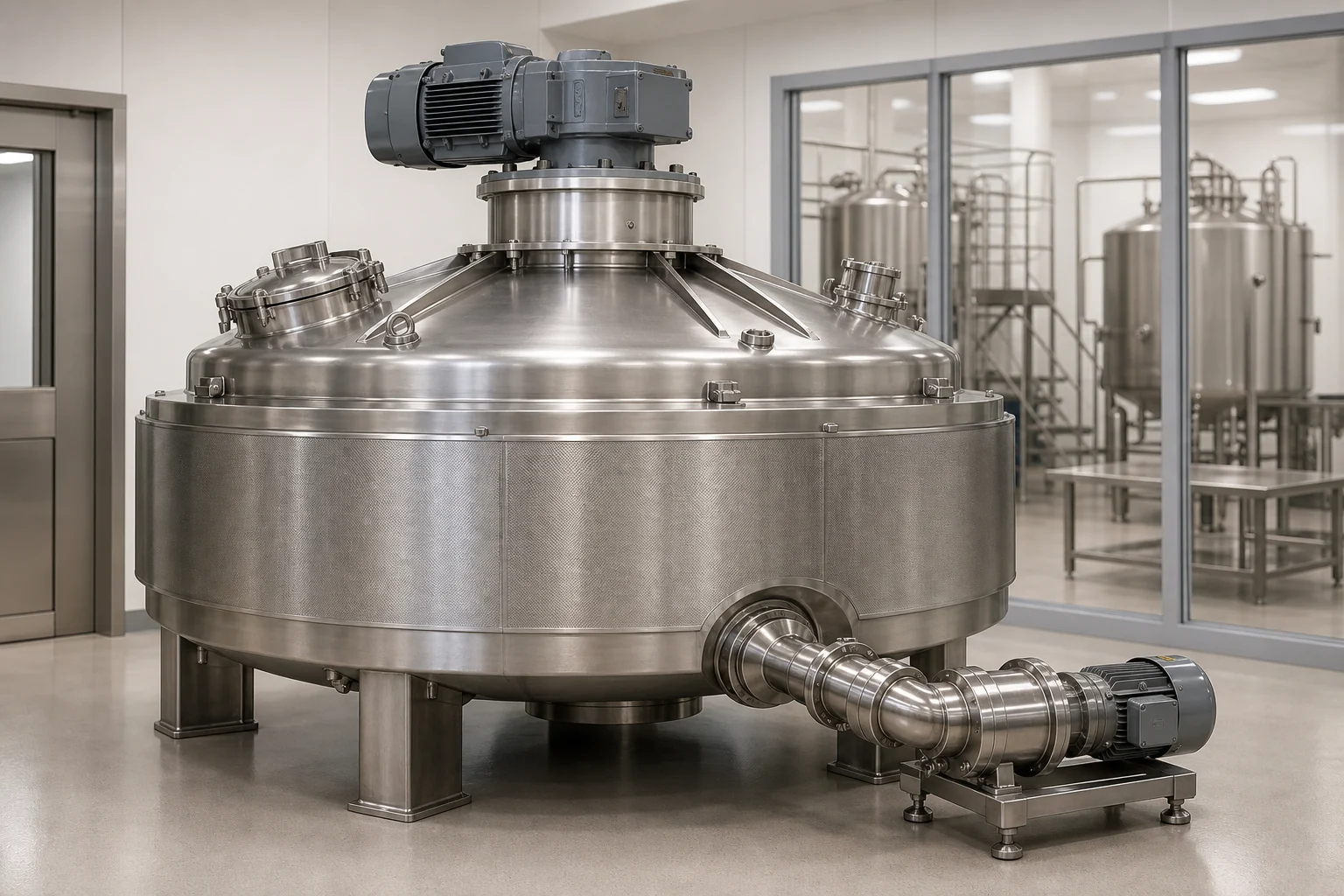
A high-viscosity compounding tank uses an agitator such as an anchor, frame or wall-sweeping design to move viscous product through the vessel. Geometry, torque, temperature, product rheology and discharge method must be engineered together.
As viscosity rises, circulation becomes more difficult and mixer torque, wall build-up, heat-transfer rate and discharge time become more important. Product behaviour may also change significantly during heating, cooling or ingredient addition.
Vessentra evaluates the full viscosity range and batch profile before defining the vessel, drive, agitator, clearances, scraper concept and outlet. Final mixer performance remains specific to the formulation and operating levels.
Typical applications
Application details are reviewed before equipment configuration is finalised.
Engineering configuration
The equipment is developed from process inputs, operating conditions, cleaning requirements and site interfaces.
Viscosity range, yield behaviour, temperature and batch level establish the agitator and drive basis.
Frame geometry, clearances and optional scraper materials are selected for bulk turnover and wall management.
Jacket, surface area and agitation are coordinated because heat transfer can be limiting in viscous products.
Bottom geometry, outlet size, pump type and transfer temperature are reviewed for practical batch recovery.
Specification guidance
Project limits are confirmed through engineering review. These fields describe the decisions needed for an accurate, application-specific configuration.
| Viscosity basis | Defined across full batch temperature and composition range |
|---|---|
| Agitator type | Anchor, frame or project-specific wall-sweeping design |
| Drive | High-torque geared arrangement |
| Scrapers | Optional compatible wall or bottom scraper system |
| Thermal control | Jacketed and insulated options |
| Vessel geometry | Selected for circulation and discharge |
| Outlet and transfer | Configured for final product rheology |
| Cleaning | Manual or project-specific CIP-ready arrangement |
Common questions
It is often considered for viscous products that need bulk turnover and movement close to the vessel wall, subject to the complete rheology and process duty.
No. They may help manage wall build-up and heat transfer in suitable products, but compatibility, wear, cleaning and product sensitivity must be reviewed.
Yes, if the maximum viscosity, changing torque, heat-transfer requirement and discharge temperature are included in the design basis.
The method may use gravity, positive-displacement pumping, pressure assistance or a combination, depending on rheology, outlet geometry and downstream equipment.
Talk to engineering
Share the product, working volume, operating conditions, cleaning method and project location. We will use them to structure the next engineering conversation.