Weighing basis
Maximum filled mass, smallest ingredient quantity, target resolution and operating environment establish the measurement basis.

Weight-based batch preparation
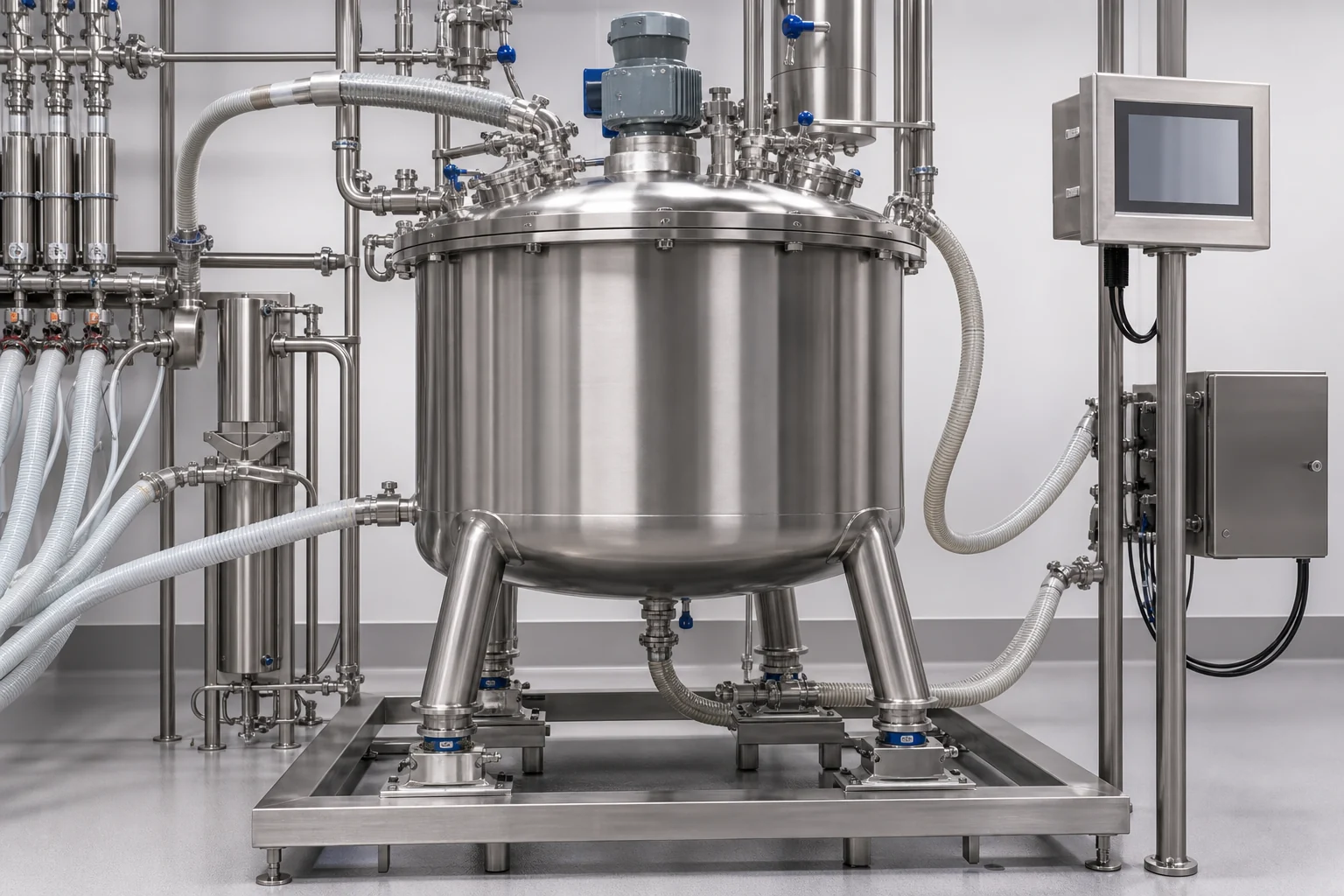
A compounding vessel mounted on load cells to support weight-based ingredient addition, batch confirmation and recipe repeatability.
Quick answer
A load cell weighing compounding tank measures vessel weight as ingredients are added or product is discharged. It can support recipe dosing and material balance when the mechanical supports, connected piping and control logic are designed to protect measurement performance.
Accurate weighing is a system property, not only a sensor specification. Vessel support, pipe flexibility, agitator loads, thermal movement, vibration, wind and installation conditions can all influence the reading.
Vessentra coordinates the tank frame, load cells, junction hardware, flexible connections and controls. Required resolution and acceptance testing are agreed from the actual ingredient quantities and batch process.
Typical applications
Application details are reviewed before equipment configuration is finalised.
Engineering configuration
The equipment is developed from process inputs, operating conditions, cleaning requirements and site interfaces.
Maximum filled mass, smallest ingredient quantity, target resolution and operating environment establish the measurement basis.
Load cells, restraints, frame stiffness and mixer forces are reviewed as a complete structural arrangement.
Pipes, hoses, cables and utility connections are arranged to limit unwanted force transfer into the weighing system.
Dosing logic, zeroing, alarms, calibration access and batch records can be integrated to the agreed scope.
Specification guidance
Project limits are confirmed through engineering review. These fields describe the decisions needed for an accurate, application-specific configuration.
| Weighing capacity | Defined from vessel tare and maximum operating mass |
|---|---|
| Batch resolution | Agreed from recipe quantities and system conditions |
| Load cell arrangement | Project-specific number and mounting hardware |
| Process connections | Flexible or mechanically isolated where required |
| Agitation | Mixer loads considered in measurement design |
| Controls | Local indication or recipe-system integration |
| Calibration | Access and method defined with project |
| Cleaning | Hygienic vessel and washdown-compatible installation |
Common questions
Weight measurement can directly support material addition across products with different density, while level measurement is often better suited to inventory or process-state indication.
They can. Rigid pipes and hoses can apply forces to the vessel, so connection flexibility and routing must be included in the weighing design.
Possibly, but the required resolution must be checked against total capacity and real installation conditions. A separate dosing method may suit very small additions.
Yes. The load-cell signal can be integrated into project-specific PLC, batch or data systems when the interface and record requirements are defined.
Talk to engineering
Share the product, working volume, operating conditions, cleaning method and project location. We will use them to structure the next engineering conversation.