Recipe sequence
Addition points, valves and instruments are organised around the actual order of operations and operator actions.

Repeatable hygienic formulation
A hygienic formulation vessel configured around recipe order, ingredient behaviour, batch conditions, cleaning and finished-product transfer.
Quick answer
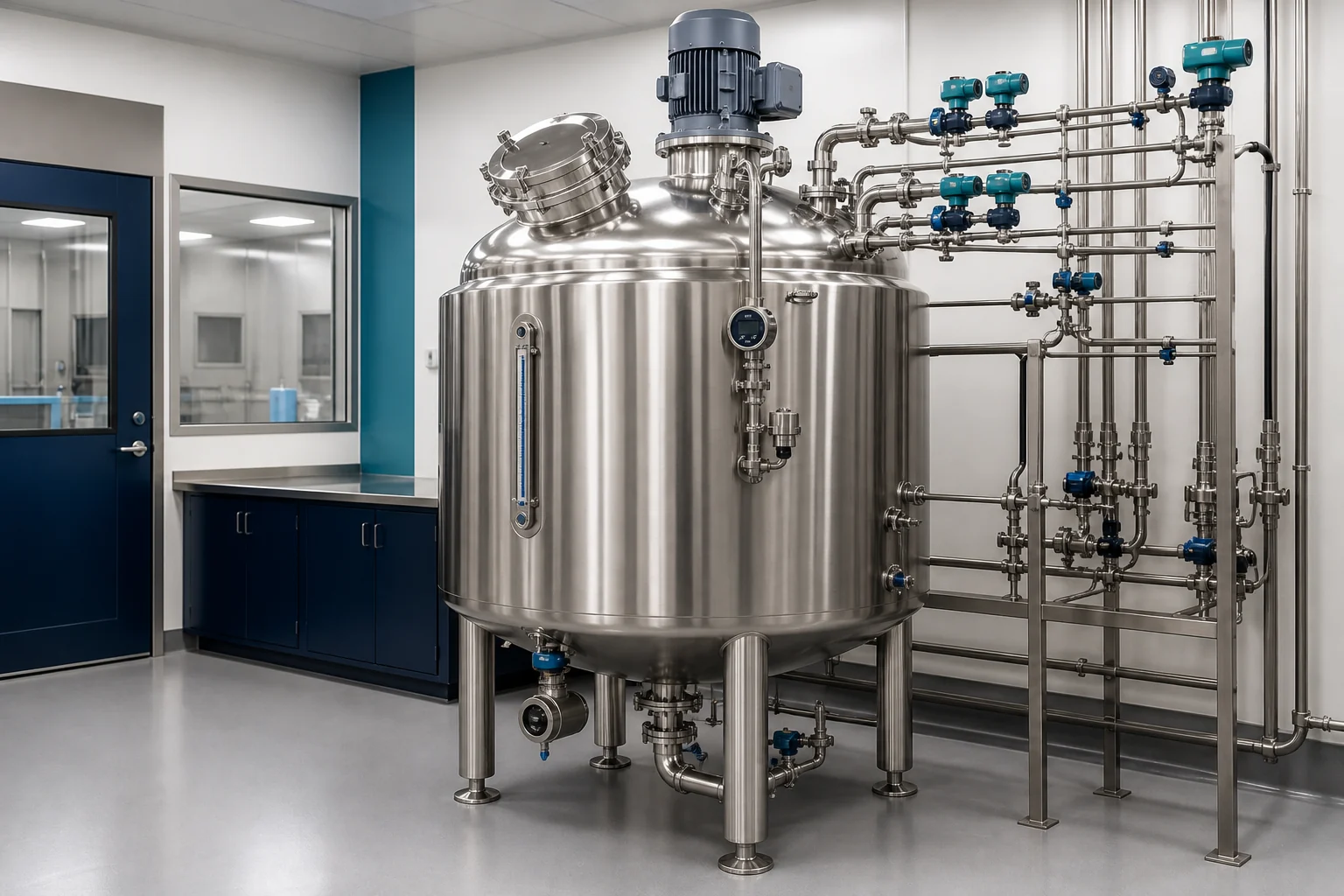
A sanitary stainless steel formulation tank combines controlled ingredient addition, mixing, measurement and cleanable product contact in one batch vessel. It is used when repeatable recipe execution matters as much as the basic mixing result.
Formulation begins with the operating sequence. Charge order, addition rate, temperature, mixing time, hold steps and final transfer determine how the vessel should be arranged for repeatable production.
Vessentra coordinates the tank, agitator, addition ports, instruments, valves and cleaning devices as one process unit. Product-contact material, finish and automation scope are confirmed from the product and site requirements.
Typical applications
Application details are reviewed before equipment configuration is finalised.
Engineering configuration
The equipment is developed from process inputs, operating conditions, cleaning requirements and site interfaces.
Addition points, valves and instruments are organised around the actual order of operations and operator actions.
Agitator, impeller and speed range are selected for dissolution, uniformity, suspension or gentle circulation.
Temperature, level, weight and other measurements can support repeatable batch decisions and records.
Spray coverage, drainability, outlet geometry and downstream connections are reviewed as one hygienic path.
Specification guidance
Project limits are confirmed through engineering review. These fields describe the decisions needed for an accurate, application-specific configuration.
| Working volume | Sized to usable batch range and headspace |
|---|---|
| Product-contact material | Stainless steel selected for product and cleaning compatibility |
| Agitation | Duty-specific impeller and speed arrangement |
| Ingredient addition | Project-positioned liquid and dry-addition interfaces |
| Thermal control | Optional jacket and insulation |
| Process measurement | Temperature, level, weight and project-specific options |
| Cleaning | Manual or CIP-ready configuration |
| Controls | Local or sequence-based automation to project scope |
Common questions
A formulation tank is developed around the complete recipe sequence, including ingredient addition, measurement, temperature steps, hold times, cleaning and transfer rather than only the mixing action.
Provide batch volumes, ingredient list, order of addition, product properties, temperature profile, required mixing result, cleaning method and transfer sequence.
Yes. Dosing valves, pumps, load cells and sequence controls can be evaluated when accuracy, utilities and the plant control philosophy are defined.
Yes. Elevation, nozzle positions, piping, utilities, controls and available space can be coordinated with the installed process.
Talk to engineering
Share the product, working volume, operating conditions, cleaning method and project location. We will use them to structure the next engineering conversation.