Vacuum objective
Air removal, foam control, assisted transfer or ingredient handling is defined before equipment selection.

Controlled air and foam management
A sealed compounding vessel that uses project-defined vacuum to support air removal, foam management and controlled batch preparation.
Quick answer
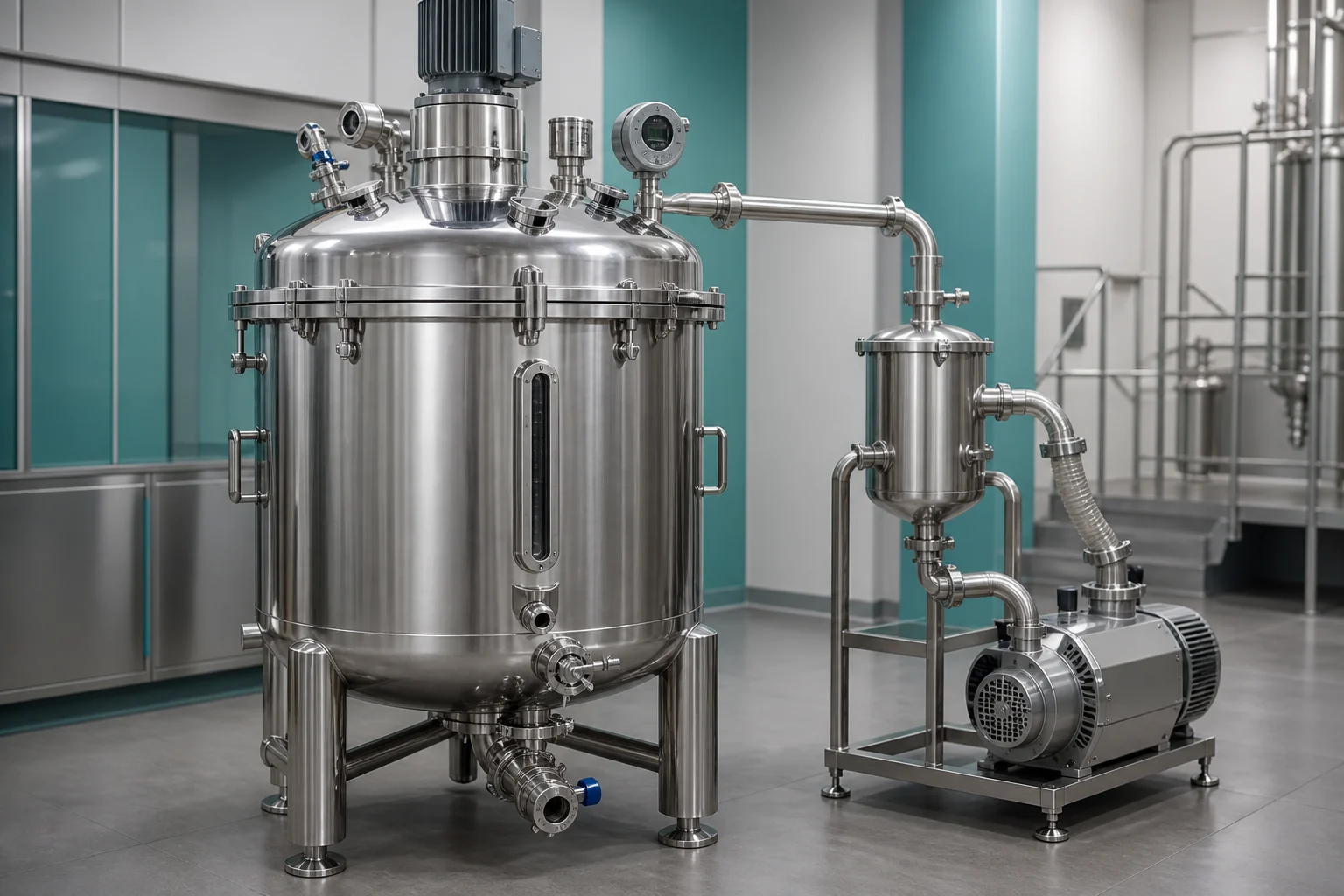
A vacuum compounding tank processes a formulation in a sealed vessel while reducing pressure to help manage entrained air, foam or oxygen exposure. The vacuum level, mixer and condenser or protection equipment must match the product and operating sequence.
Vacuum can improve appearance, density control, filling behaviour or oxidation management in suitable formulations, but it is not automatically beneficial for every product. Volatility, foaming tendency and temperature must be reviewed first.
Vessentra coordinates vessel mechanical design, seals, vacuum source, venting, instrumentation and product transfer. Safeguards are developed around the defined vacuum envelope and cleaning process.
Typical applications
Application details are reviewed before equipment configuration is finalised.
Engineering configuration
The equipment is developed from process inputs, operating conditions, cleaning requirements and site interfaces.
Air removal, foam control, assisted transfer or ingredient handling is defined before equipment selection.
Mechanical design, agitator seal, manway and instruments are specified for the agreed pressure and vacuum envelope.
Pump type, protection, condensate handling and control are selected from vapour load and process conditions.
Pressure equalisation, outlet geometry and transfer equipment are coordinated with final viscosity and downstream needs.
Specification guidance
Project limits are confirmed through engineering review. These fields describe the decisions needed for an accurate, application-specific configuration.
| Operating mode | Project-defined vacuum and atmospheric states |
|---|---|
| Product-contact material | Selected for product and cleaning compatibility |
| Agitation | Matched to formulation and deaeration objective |
| Vacuum source | Selected from duty and vapour conditions |
| Vapour protection | Project-specific trap, filter or condenser options |
| Instrumentation | Vacuum, temperature, level and project-specific options |
| Discharge | Configured for final product rheology |
| Cleaning | Manual or CIP-ready configuration |
Common questions
For suitable products it can help remove entrained air, manage foam, reduce oxygen exposure or support a controlled addition step.
It requires careful review because reduced pressure can increase evaporation. Product composition, temperature and vapour handling must be considered.
Only when the vessel and all connected components are specifically engineered for the complete agreed operating envelope.
No. Vacuum manages the vessel atmosphere; dispersion or emulsification performance depends on the selected mixing equipment and formulation.
Talk to engineering
Share the product, working volume, operating conditions, cleaning method and project location. We will use them to structure the next engineering conversation.