Capacity and payload
Working volume, product density and equipment weight are checked against mobility and floor-loading constraints.

Flexible small-batch production
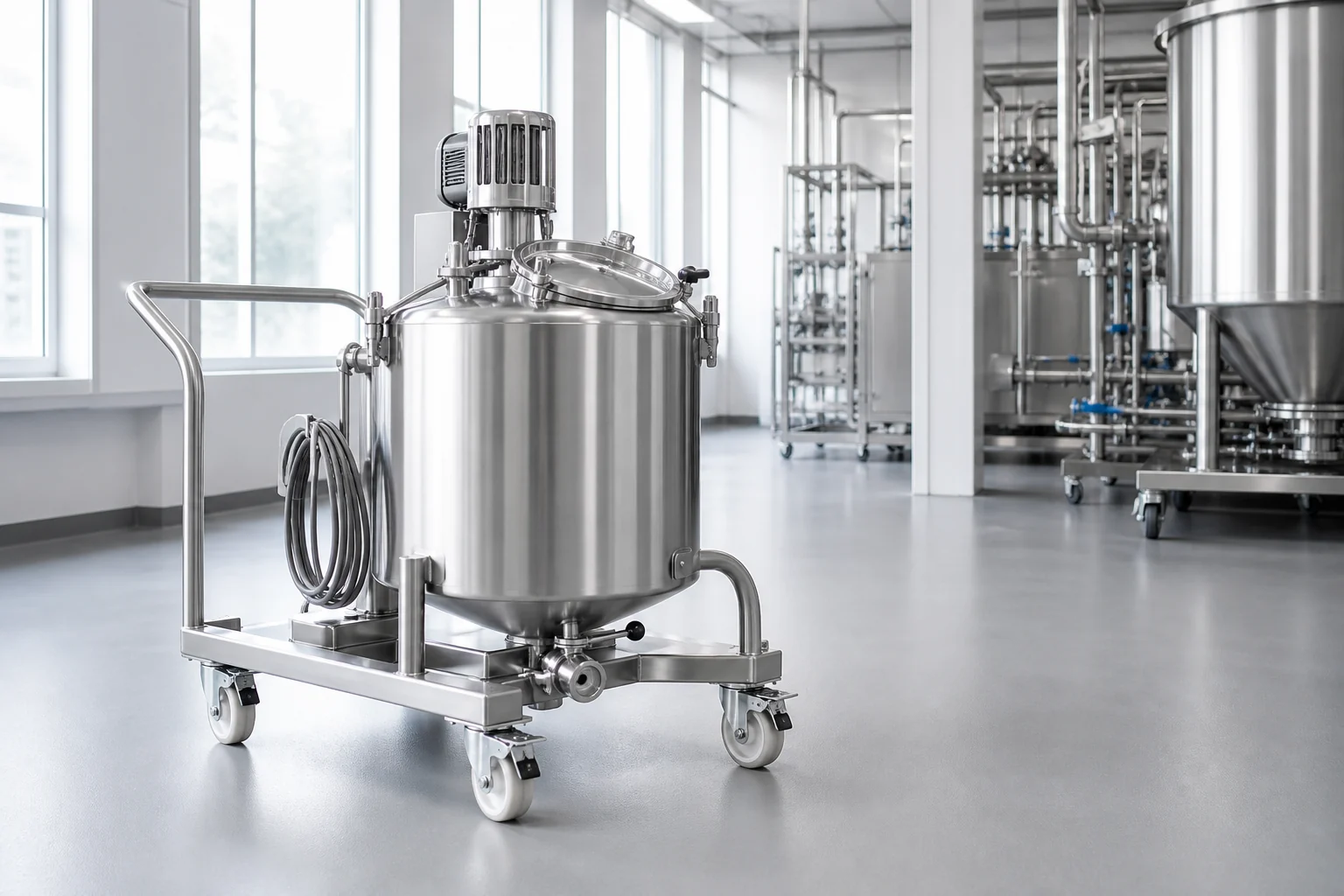
A compact wheeled mixing vessel for small batches, pilot work and flexible movement between compatible production stations.
Quick answer
A mobile stainless steel mixing tank combines a small-batch vessel, agitator and lockable castors so one unit can serve compatible work areas. Capacities around 100–1000 litres are often evaluated, with final size limited by product load, floor conditions and safe handling.
Mobility affects the entire design. Filled weight, centre of gravity, doorway clearance, hoses, power connection, braking and operator route must be considered alongside the mixing duty.
Vessentra configures the frame, handles, castors, lid, agitator and discharge around the intended batch sequence. Movement rules and suitability of the operating floor remain part of the site risk assessment.
Typical applications
Application details are reviewed before equipment configuration is finalised.
Engineering configuration
The equipment is developed from process inputs, operating conditions, cleaning requirements and site interfaces.
Working volume, product density and equipment weight are checked against mobility and floor-loading constraints.
Compact drive, impeller, guard and lid arrangement are selected for the product and operator interface.
Frame, handles and braked castors are configured for the intended route and clean production environment.
Power, earthing, flexible hoses, outlet position and pump connection are coordinated with each workstation.
Specification guidance
Project limits are confirmed through engineering review. These fields describe the decisions needed for an accurate, application-specific configuration.
| Capacity range | Commonly evaluated around 100–1000 L |
|---|---|
| Mobility | Braked castors and project-specific frame |
| Product-contact material | Stainless steel selected for compatibility |
| Agitator | Compact duty-matched arrangement |
| Speed control | Fixed or variable speed option |
| Lid and guarding | Configured for process and operator needs |
| Discharge | Drainable outlet and transfer options |
| Cleaning | Manual or project-specific CIP-ready design |
Common questions
Size the tank from usable batch volume, required headspace, product density, mixing level and the maximum safe mobile load for the route and floor.
That depends on total weight, centre of gravity, castors, floor condition, gradients, obstacles and the site handling assessment. The intended movement state must be defined during design.
Yes. A suitable drive and control can be selected when the required speed range, power supply, environment and operator controls are known.
Provide doorway widths, floor type, gradients, drains, available utilities, operating stations, cleaning area and any hazardous-area or hygiene constraints.
Talk to engineering
Share the product, working volume, operating conditions, cleaning method and project location. We will use them to structure the next engineering conversation.