Sterile boundary
Vessel penetrations, valves, seals, vents and sampling points are reviewed as one controlled product-contact boundary.

Controlled sterile holding
A controlled storage vessel for products that require sterile holding, protected interfaces and coordinated cleaning and sterilisation cycles.
Quick answer
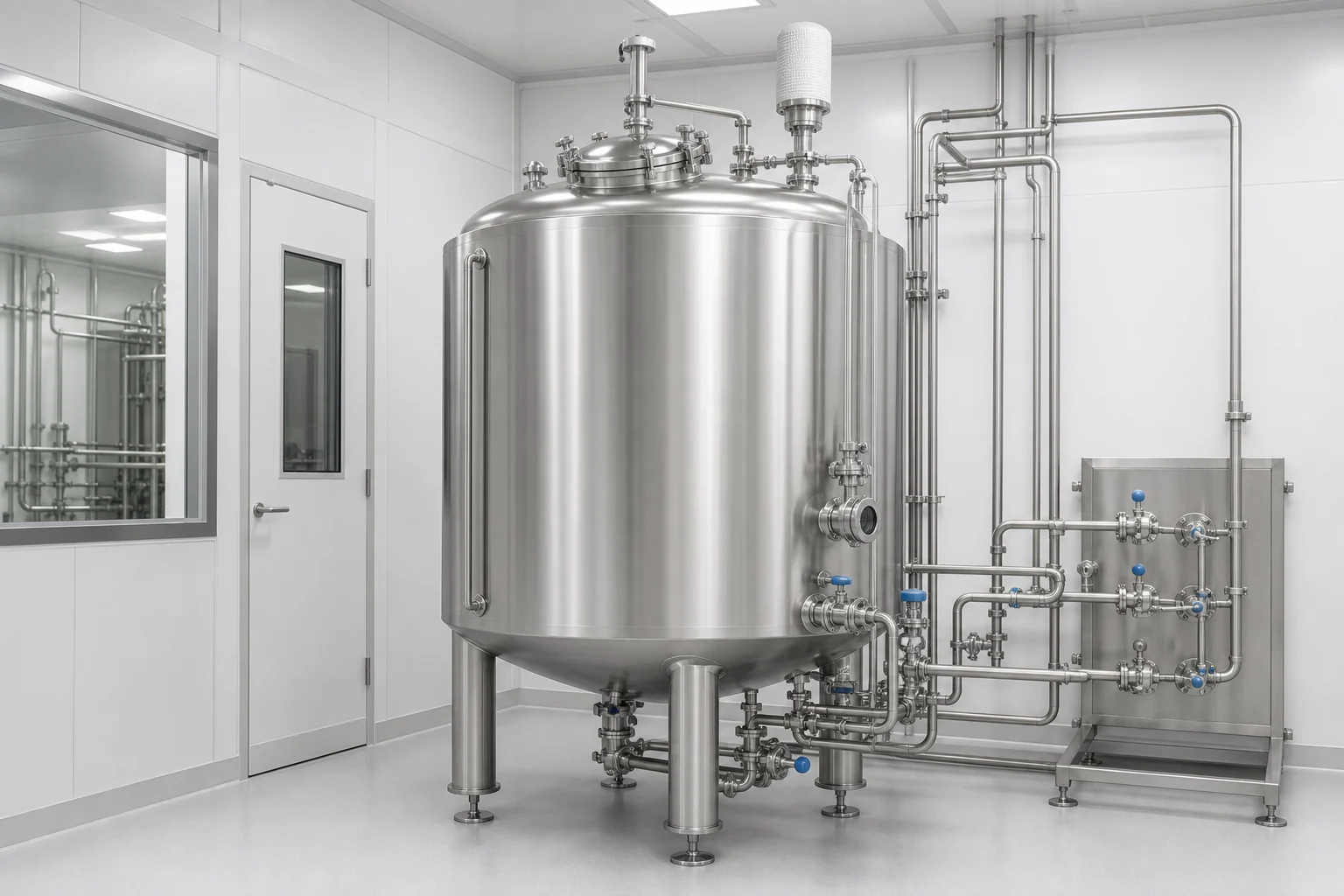
An aseptic stainless steel storage tank protects a sterilised or microbiologically sensitive product during holding and transfer. Aseptic performance depends on the complete boundary—including vessel, valves, vent, instruments, seals, cleaning, sterilisation and operating procedure.
Aseptic duty cannot be created by a tank label alone. Every product-contact interface must support the defined sterilisation strategy and avoid uncontrolled exposure after the validated cycle.
Vessentra develops the vessel around the contamination-control concept, sterile boundary, SIP sequence, condensate management, aseptic transfer and required documentation. The final scope is confirmed with the project quality and process teams.
Typical applications
Application details are reviewed before equipment configuration is finalised.
Engineering configuration
The equipment is developed from process inputs, operating conditions, cleaning requirements and site interfaces.
Vessel penetrations, valves, seals, vents and sampling points are reviewed as one controlled product-contact boundary.
Steam distribution, air removal, temperature monitoring and condensate drainage are coordinated with the intended SIP procedure.
Inlet, outlet and sampling arrangements are selected to maintain control during connection, holding and discharge.
Vent filtration and pressure or vacuum protection are designed for processing, sterilisation and cool-down states.
Specification guidance
Project limits are confirmed through engineering review. These fields describe the decisions needed for an accurate, application-specific configuration.
| Process duty | Aseptic or microbiologically controlled holding |
|---|---|
| Product-contact material | Selected for process and sterilisation compatibility |
| Sterile boundary | Project-defined vessel and component scope |
| Sterilisation | SIP-ready design where specified |
| Vent system | Sterile filtration and pressure protection options |
| Transfer | Controlled hygienic or aseptic interfaces |
| Instrumentation | Cleanable, sterilisation-compatible options |
| Documentation | Agreed validation-support package |
Common questions
Aseptic performance comes from the complete hygienic design, sterile boundary, validated cleaning and sterilisation cycles, protected transfer and disciplined operation—not from material grade alone.
The sterilisation method depends on the process and contamination-control strategy. Where steam-in-place is specified, the tank and all boundary components must be designed for that cycle.
A sterile-grade filtration arrangement and suitable pressure or vacuum protection can be configured around filling, emptying, sterilisation and cool-down conditions.
A vessel may support more than one product when process compatibility, allergen control, cleaning, sterilisation and changeover validation have been assessed for the full range.
Talk to engineering
Share the product, working volume, operating conditions, cleaning method and project location. We will use them to structure the next engineering conversation.