Product-contact design
Wetted materials, surface treatment, weld finishing and elastomers are defined against the product and cleaning regime.

Controlled pharmaceutical holding
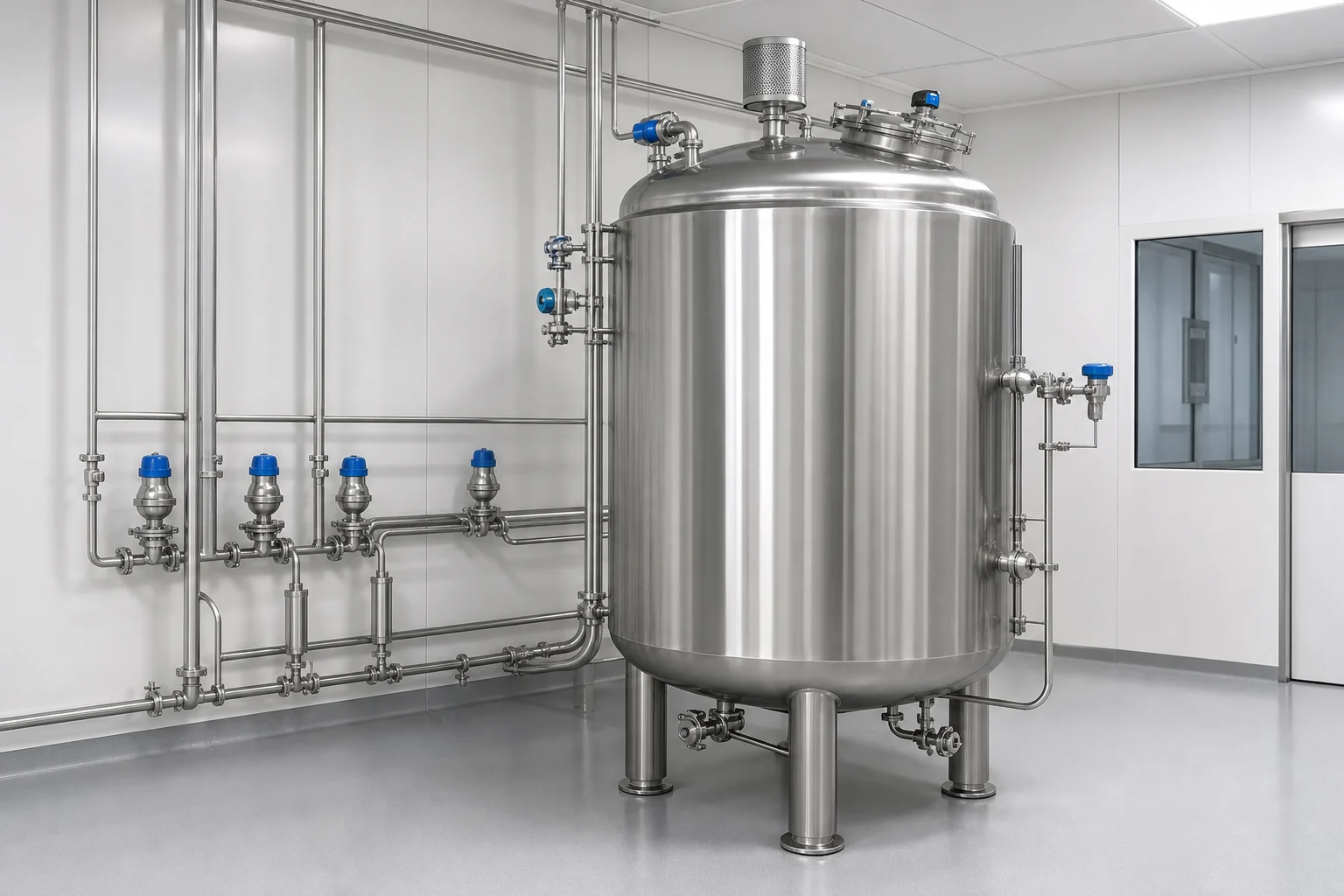
A 316L product-contact vessel configured for controlled storage, hygienic transfer and documented pharmaceutical process integration.
Quick answer
A 316L pharmaceutical storage tank is used where corrosion resistance, cleanability, controlled product contact and documentation are central to the process. The final design must align with the user requirement specification, cleaning strategy and applicable project standards.
Pharmaceutical storage is defined by more than material grade. Surface treatment, weld quality, dead-leg control, drainability, venting, sampling and cleaning coverage all affect how the vessel performs in the validated process.
Vessentra develops the tank from the project URS and coordinates product-contact components, instruments and documentation with the intended qualification approach. GMP, regulatory and code requirements are confirmed for the destination and agreed scope.
Typical applications
Application details are reviewed before equipment configuration is finalised.
Engineering configuration
The equipment is developed from process inputs, operating conditions, cleaning requirements and site interfaces.
Wetted materials, surface treatment, weld finishing and elastomers are defined against the product and cleaning regime.
Spray coverage, condensate removal, venting and utility interfaces are reviewed around the intended cleaning or sterilisation cycle.
Level, temperature, pressure and sampling devices can be selected with cleanable, drainable process connections.
Material records, weld records, surface reports and test documentation can be structured to the agreed project requirements.
Specification guidance
Project limits are confirmed through engineering review. These fields describe the decisions needed for an accurate, application-specific configuration.
| Product-contact material | 316L stainless steel |
|---|---|
| Surface treatment | Defined by the hygiene and validation strategy |
| Operating mode | Atmospheric, low-pressure or project-defined duty |
| Cleaning | CIP-ready configuration available |
| Sterilisation | SIP-ready features available where required |
| Drainability | Geometry reviewed for the intended process state |
| Instrumentation | Hygienic project-specific instruments |
| Documentation | Agreed traceability and test package |
Common questions
316L offers useful corrosion resistance and is widely used for hygienic product-contact equipment. Suitability still depends on product chemistry, temperature, cleaning media and the project specification.
No. Material grade alone does not establish GMP suitability. Design, fabrication, documentation, installation, cleaning and operation must be considered as a complete system.
Yes, when cleaning coverage, steam distribution, venting, condensate removal, seals and instruments are engineered for the intended cycles.
Provide the URS where available, working volume, medium, operating conditions, cleaning and sterilisation cycles, surface requirements, instrumentation, documentation and installation location.
Talk to engineering
Share the product, working volume, operating conditions, cleaning method and project location. We will use them to structure the next engineering conversation.