Mobility assessment
Gross weight, floor surface, thresholds, travel route and handling frequency are reviewed before wheel selection.

Flexible batch movement
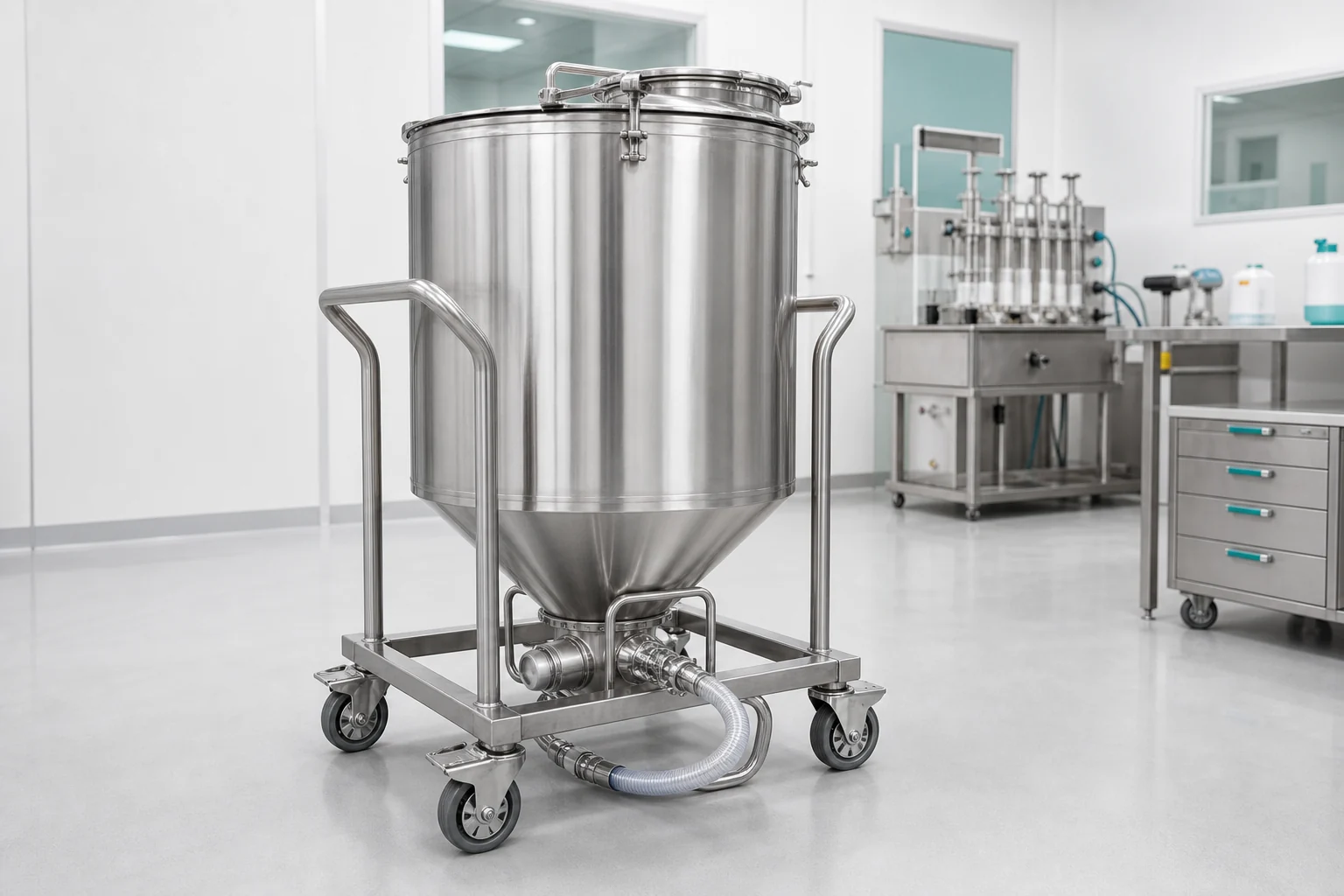
A compact hygienic vessel on a mobile base for flexible batch holding, staging and internal product transfer.
Quick answer
A mobile sanitary storage tank allows smaller liquid batches to be held and moved between process steps without fixed pipework. Capacity, caster rating, centre of gravity, floor conditions and operator handling must be considered together for safe use.
Mobility can simplify pilot production, changeovers and staging, but it introduces mechanical and ergonomic requirements that a fixed tank does not have. The vessel must remain stable during movement, connection, filling and discharge.
Vessentra develops the frame, handles, wheel arrangement, brakes, lid and connections around the intended route, batch weight and operator workflow. Product transfer may be by gravity, mobile pump or connection to a process station.
Typical applications
Application details are reviewed before equipment configuration is finalised.
Engineering configuration
The equipment is developed from process inputs, operating conditions, cleaning requirements and site interfaces.
Gross weight, floor surface, thresholds, travel route and handling frequency are reviewed before wheel selection.
Wheelbase, tank height, supports and brakes are developed to manage centre of gravity during normal operation.
Open-top, hinged or sealed closures can be considered according to contamination control and cleaning needs.
Gravity discharge, mobile pumping or docking connections are arranged around the receiving equipment.
Specification guidance
Project limits are confirmed through engineering review. These fields describe the decisions needed for an accurate, application-specific configuration.
| Working volume | Small and intermediate batch sizes |
|---|---|
| Product-contact material | Hygienic stainless steel selected by duty |
| Mobility | Caster and brake system sized for gross load |
| Frame | Stable stainless steel support arrangement |
| Closure | Open, covered or sealed options |
| Discharge | Gravity, mobile pump or docking connection |
| Cleaning | Manual or project-specific spray cleaning |
| Handling | Handles and interfaces arranged for workflow |
Common questions
The practical capacity depends on product density, total moving weight, floor conditions, route, doorway clearance and how operators will handle the vessel.
Yes, but mixer weight, power connection, stability, minimum liquid level and safe movement must be considered as part of the complete mobile assembly.
Wheel brakes and, where needed, docking or restraint features can be selected around the operating station and floor conditions.
Only when the complete assembly has been designed and assessed for the stated filled load and travel conditions. The intended operating procedure should define when movement is permitted.
Talk to engineering
Share the product, working volume, operating conditions, cleaning method and project location. We will use them to structure the next engineering conversation.