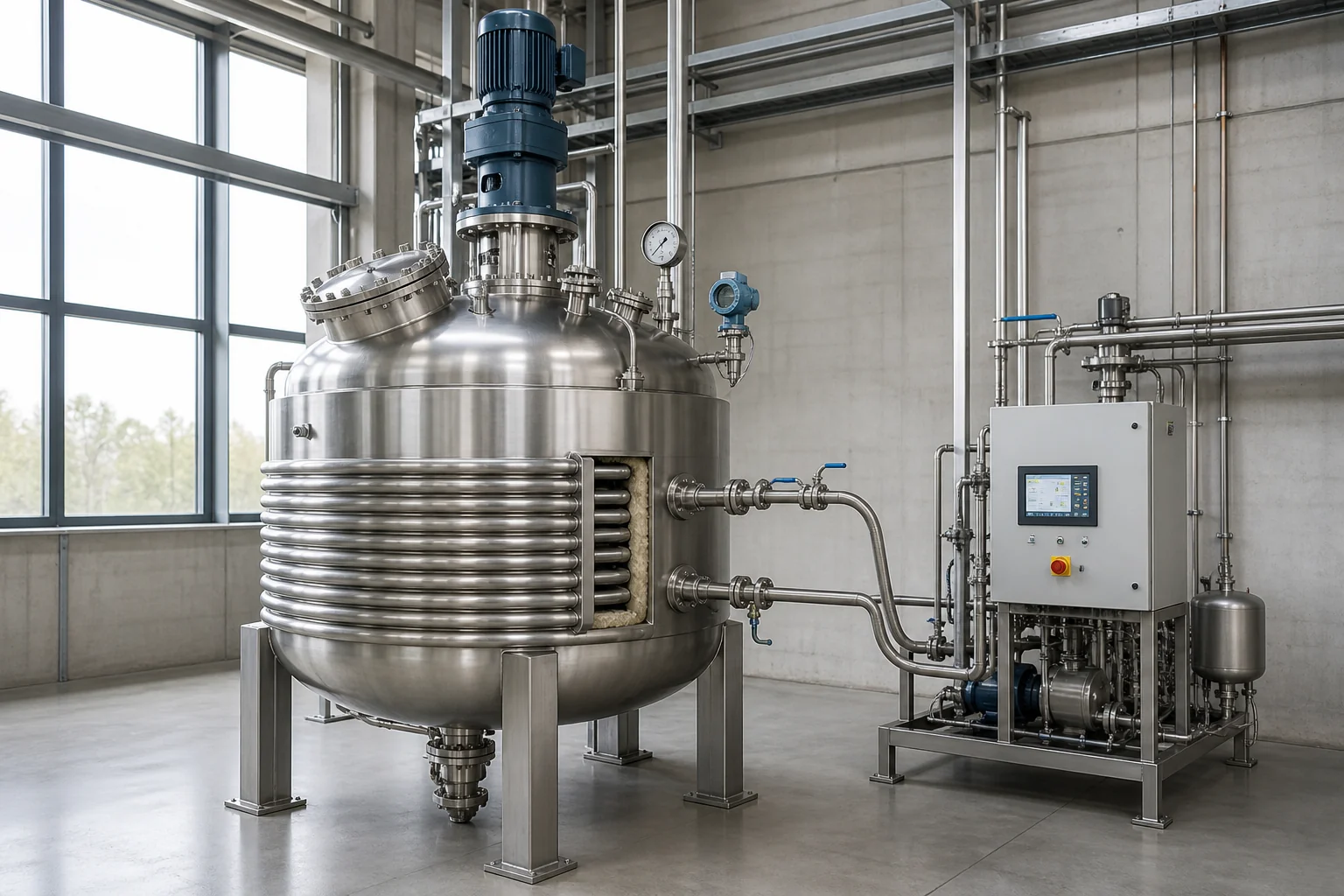
Jacket arrangement
Conventional, dimple or half-pipe jacket zones are selected from pressure, utility, heat-transfer area and fabrication requirements.

Reaction-led agitation and heat transfer
A temperature-controlled agitated reactor engineered to manage reaction heat load, evolving viscosity and defined batch conditions.
Quick answer
A jacketed agitated reactor vessel combines mechanical mixing with a heat-transfer surface around the vessel shell or head. Unlike a general jacketed mixing tank, its agitation, jacket area, utility flow, seal, pressure envelope and controls are selected from the reaction temperature profile and heat load.
The critical design question is not simply whether the vessel can heat and cool. The system must deliver or remove heat at the rate required during charging, reaction, hold and quench while agitation maintains the intended blend, suspension or dispersion state.
Vessentra evaluates jacket type and zones together with impeller flow, wall film behavior, utility temperatures, control-valve response and site services. This integrated approach supports a stable temperature trajectory across the planned operating range.
Typical applications
Application details are reviewed before equipment configuration is finalised.
Engineering configuration
The equipment is developed from process inputs, operating conditions, cleaning requirements and site interfaces.
Conventional, dimple or half-pipe jacket zones are selected from pressure, utility, heat-transfer area and fabrication requirements.
Impeller geometry and speed range are checked as density, viscosity, solids content or gas loading changes during the batch.
Flow, supply temperature, return conditions, control valves and optional temperature-control unit are matched to the calculated duty.
Temperature, pressure, agitation and utility permissives can be incorporated according to the process hazard review and control philosophy.
Specification guidance
Project limits are confirmed through engineering review. These fields describe the decisions needed for an accurate, application-specific configuration.
| Reaction service | Temperature-controlled agitated batch reaction |
|---|---|
| Jacket type | Conventional, dimple or half-pipe arrangement by project |
| Thermal duty | Calculated from batch profile and utility conditions |
| Agitation | Duty-selected impeller, baffles and speed range |
| Operating envelope | Project-specific pressure, vacuum and temperature |
| Seal system | Selected for containment, chemistry and shaft conditions |
| Insulation | Optional insulation and hygienic or industrial cladding |
| Controls | Temperature cascade, recipe sequence and interlock options |
Common questions
A jacketed reactor is designed from the reaction heat load, kinetics, temperature trajectory, pressure, venting and containment requirements. A mixing tank jacket may only need routine heating or cooling for blending.
The choice depends on vessel size, required area, utility pressure and temperature, heat-transfer coefficient, fouling risk, cycling duty and fabrication standard. Thermal calculations should guide the selection.
Agitation renews the product film at the vessel wall and distributes heat through the batch. An unsuitable impeller or speed can create poor wall-side transfer, temperature gradients or solids settling even when adequate jacket area is installed.
Yes, when the jacket, utility switching, return path and controls are designed for both services. Transition time, thermal shock, condensate management and cross-contamination risk between utility circuits must be reviewed.
Protection is process-specific and may involve feed interruption, emergency cooling, quench strategy, relief or vent systems and independent instrumentation. These measures must come from a formal reaction and process hazard assessment.
Talk to engineering
Share the product, working volume, operating conditions, cleaning method and project location. We will use them to structure the next engineering conversation.